
Sailing stones (Racetrack Playa)
데스밸리 움직이는 돌 (레이스트랙 플라야)
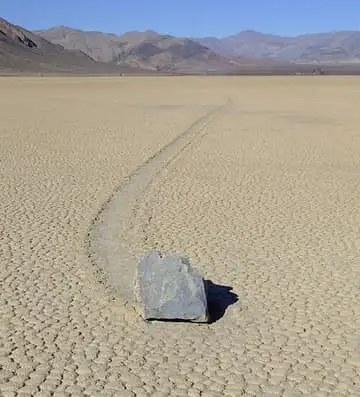
On Racetrack Playa, a bone-dry lakebed in Death Valley, rocks seem to wander across the ground on their own, leaving long, curving trails behind them. The mystery puzzled scientists for decades until 2014, when cameras caught the answer: after rare winter rain, thin sheets of ice form, break up in the sun, and gentle winds push the ice panels, which shove even rocks of hundreds of kilograms slowly along the mud.
See it on the 3D globe →At a glance
- Country
- United States
- Kind
- Mysteries
Quick answers
Where is Sailing stones (Racetrack Playa)?
Sailing stones (Racetrack Playa) is in United States.
Sailing stones are rocks that seem to slide across flat ground on their own, leaving long trails behind them. The most famous ones are on Racetrack Playa, a dry lakebed in Death Valley National Park, California.
For many years nobody had seen the stones move, so scientists could only guess why. In 2014, time-lapse video finally showed the answer. When rain floods the playa and thin ice forms, the ice breaks into sheets that are pushed by wind, and the sheets shove the stones slowly across the wet mud. The case is a solved mystery. For decades, the tracks made visitors wonder whether a hidden force was at work.
What the stones and tracks are like
Most of the moving stones are about 15 to 46 centimetres wide. They leave tracks that are 8 to 30 centimetres wide, usually less than 2.5 centimetres deep, and sometimes up to 100 metres long. Stones with rough bottoms make straight scratches, while smooth ones tend to wander. Some stones flip over and leave a different track, and two stones that start side by side may go separate ways. Most of the rocks fell from nearby cliffs of dark dolomite and syenite.
How scientists solved it
People studied the tracks from the early 1900s, and the first written account dates to 1915. Many ideas were tried over the years. The break came in 2014, when researchers published video of stones moving in the thin, melting ice sheets, an effect called ice shove. Several things need to happen at once: a flooded surface, a thin layer of slippery clay, wind, floating ice, and warmer weather that makes the ice break up.
Fun facts
- In 2014 scientists caught the stones moving: thin sheets of ice, pushed by light winds, slide them across the muddy playa.
- The tracks can be as long as 100 metres.
- The stones are moved by thin sheets of ice and wind, not by animals or people.
- Sailing stones have also been seen at Little Bonnie Claire Playa in Nevada.
On the globe
The model shows a flat, dry lakebed with rocks and long, curving trails behind them. Look for the tracks.
Nearby on the globe


Sources
Updated: 2026-10-14