
Svalbard Global Seed Vault
스발바르 국제 종자 저장고
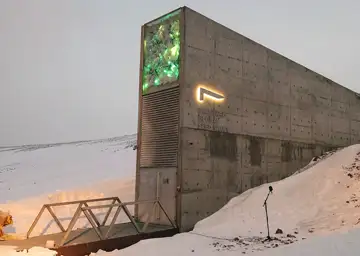
Deep inside a frozen mountain on Norway's Arctic islands of Svalbard, this "doomsday vault" keeps backup copies of the world's crop seeds at −18 °C. It opened in 2008 so that crops can be regrown even if war or disaster destroys a country's seed bank; it now holds more than 1.3 million seed samples and is closed to visitors. In 2015, when the war in Syria shut a seed bank near Aleppo, scientists made the first withdrawal to regrow those crops, and above the door an artwork of mirrors and prisms glows turquoise even in the dark polar night.
See it on the 3D globe →At a glance
- Country
- Norway
- Type
- Infrastructure
- Kind
- Off-limits places
Quick answers
Where is Svalbard Global Seed Vault?
Svalbard Global Seed Vault is in Norway.
The Svalbard Global Seed Vault is a safe backup storage for the world's crop seeds. It sits in the Arctic, on the Norwegian island of Spitsbergen in the Svalbard islands, and it is often called the 'doomsday vault'.
Seed banks around the world send duplicate seeds here to be stored for free. The seeds are kept deep in a frozen mountain at about minus 18 degrees Celsius. If a disaster, war or other trouble destroys a seed bank somewhere else, the crops can be grown again from the copies. As of June 2025, the vault held more than 1.35 million seed samples.
Why build it?
Seeds are the starting point for every kind of food crop, and each variety is slightly different. Scientist Cary Fowler campaigned for a safe, long-term backup. After a feasibility study in 2004, Norway paid the building cost of about 45 million kroner. The vault officially opened on 26 February 2008, and the first seeds had arrived in January 2008. It is managed by the Norwegian government, the Crop Trust and the Nordic Genetic Resource Center (NordGen).
How it works
Countries and institutions keep ownership of the seeds they send, and the vault only stores the boxes. The cold mountain keeps seeds frozen even if power fails. In 2015, war in Syria made it impossible to use a seed bank near Aleppo, so scientists made the first withdrawal to regrow those crops. The vault is not open to the public, but a glowing artwork of mirrors and prisms stands above the door.
Fun facts
- Deep inside an Arctic mountain it keeps more than 1.3 million seed samples frozen at −18 °C, and it has room for 4.5 million.
- The vault holds seeds representing more than 13,000 years of farming history.
- Norway paid for the whole building, and storing seeds is free for depositors.
- The vault began taking seeds in January 2008.
On the globe
The model shows a vault entrance built into a frozen Arctic mountain. Look for the glowing artwork above the door.
Quiz time
Which is older: Svalbard Global Seed Vault or Tristan da Cunha?
Show the answer
Tristan da Cunha. (2008 vs 1506) Tristan da Cunha →
Nearby on the globe

Sources
Updated: 2026-10-14