
Northern lights (Tromsø, Lyngen Alps)
오로라 (트롬쇠·링엔 알프스)
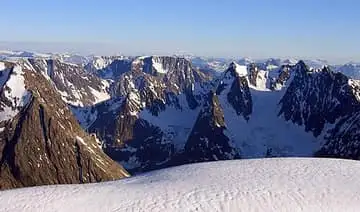
The Tromsø region of northern Norway, where the Lyngen Alps rise straight out of the fjords, lies right under the auroral oval, so on clear dark nights from September to March the northern lights often ripple overhead. Auroras glow when solar-wind particles strike oxygen (green, red) and nitrogen (blue, purple) about 100 km up and higher.
See it on the 3D globe →At a glance
- Country
- Norway
Quick answers
Where is Northern lights (Tromsø, Lyngen Alps)?
Northern lights (Tromsø, Lyngen Alps) is in Norway.
An aurora is a natural light show in the sky, made when charged particles from the Sun crash into gases in Earth's upper atmosphere. The collisions excite oxygen and nitrogen atoms, and they then give off light in colors such as green, red and purple. In the Arctic the show is called the northern lights, or aurora borealis. It appears as curtains, rays, spirals or flickers that can cover the whole sky.
The globe marks this glow over the Lyngen Alps, a mountain range in Troms county in northern Norway, east of the city of Tromsø. The range runs along the western shore of Lyngen fjord. It is at least 90 kilometres long, 15 to 20 kilometres wide, and holds about 140 glaciers. Auroras usually glow roughly 100 kilometres above the ground, far higher than any airplane flies.
What makes the lights
The Sun sends out a stream of particles called the solar wind. Bursts from coronal holes and coronal mass ejections make it faster, and this disturbs Earth's magnetic bubble, the magnetosphere.
Electrons and protons then flow down toward the poles and strike the thin air high above. Each gas glows its own color when hit.
Big magnetic storms are most common around the peak of the Sun's 11-year sunspot cycle, or in the three years after it, so the lights can then show up much farther from the poles.
Shapes in the sky
From the ground there are five main forms: a mild glow near the horizon, cloud-like patches, arcs that curve across the sky, rays that stand like stripes, and coronas that spread out from one point. Folded arcs look like curtains.
In the early 1900s, Carl Størmer and his team photographed more than 12,000 auroras from different places and worked out their height. None were below 70 kilometres, and most peaked near 100 kilometres. The brightest ones can be bright enough to read a newspaper by.
Seeing them in Norway
Auroras are best seen near the polar regions, which is why northern Norway is a famous place to look. The Lyngen Alps rise beside a long fjord with sharp peaks and glaciers, a dramatic frame for a night-sky display.
The area became the Lyngen Alps Landscape Reserve in 2004, protecting about 961 square kilometres of mountains, glaciers and valleys that are also used for Sami reindeer herding. One much-visited spot is the turquoise glacier lake Blåvatnet.
Fun facts
- Auroras glow when particles from the Sun hit gases high in the atmosphere, usually about 100–300 km above the ground.
- The word aurora comes from the Roman goddess of the dawn.
- Other planets in our Solar System, and even some comets and moons, also have auroras.
- The name 'aurora borealis' appeared in a 1649 description by Pierre Gassendi of a display seen over France in 1621.
- Because of warm ocean currents, Tromsø's mean January air temperature is about 24 degrees Celsius warmer than the average for its latitude.
On the globe
The model shows the glowing curtains of the northern lights above the peaks of northern Norway.
Nearby on the globe

Sources
Updated: 2026-10-14