
Waitomo Glowworm Caves
와이토모 반딧불이 동굴
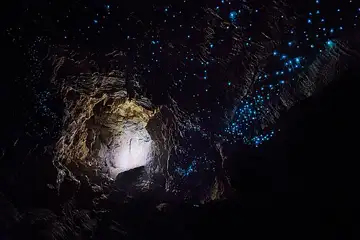
In this limestone cave at Waitomo on New Zealand's North Island, thousands of glowworms make the ceiling shine blue-green like a starry sky. They are the larvae of a tiny fungus gnat found only in New Zealand, and each lets down sticky silk threads like fishing lines to catch insects drawn to its light. Māori chief Tāne Tinorau and surveyor Fred Mace first explored it by raft in 1887, and today visitors glide silently through the Glowworm Grotto by boat on an underground stream.
See it on the 3D globe →At a glance
- Country
- New Zealand
- Kind
- Mysteries
Quick answers
Where is Waitomo Glowworm Caves?
Waitomo Glowworm Caves is in New Zealand.
The Waitomo Glowworm Cave is a limestone cave on New Zealand's North Island. Its ceiling twinkles with thousands of tiny blue-green lights made by glowworms, a species called Arachnocampa luminosa that lives only in New Zealand.
The name Waitomo comes from Māori words: wai means water and tomo means a hole or shaft. Visitors take a quiet boat ride beneath the glowing ceiling. In 2013 the cave was described as the most visited glowworm display in the world. The cave is one of New Zealand's most popular visitor attractions, and the stream that flows through it is part of a larger network of caves.
Who found the cave?
Māori had known about the cave entrance for about a century, but there is no evidence they went inside. In 1884 a local Māori man, Tane Tinorau, showed surveyors Laurence Cussen and Fred Mace the entrance. In December 1887 Tinorau and Mace built a raft and entered where the stream goes underground, exploring by candlelight. They saw the Glowworm Grotto's twinkling ceiling and amazing limestone shapes. The Crown took over the cave in 1904.
How do the glowworms glow?
The lights come from the larvae of a small fly, and each larva lights up to attract insects. The cave is in Oligocene limestone, and the Waitomo stream flows through it. The cave is part of a streamway system with other caves nearby, such as Ruakuri Cave. Tours include a boat ride, and visitors enter through a modern wooden visitor centre.
Fun facts
- The blue-green lights are glowworm larvae, found only in New Zealand, that hang sticky silk threads to catch insects drawn to their glow.
- The glowworm species Arachnocampa luminosa lives only in New Zealand.
- Tane Tinorau first knew the cave as a good spot for catching eels.
- Tinorau and Mace explored by candlelight on a raft in 1887.
On the globe
The model shows the cave with its ceiling of glowing blue-green glowworm lights.
Nearby on the globe



Sources
Updated: 2026-10-14