
Yonaguni Monument
요나구니 해저 지형
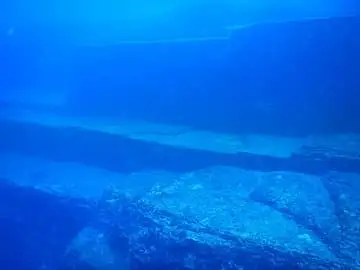
Off the south coast of Yonaguni, Japan's westernmost island, lies a huge stepped rock formation 5 to 25 m under the sea, found by a diver in 1986. Its flat terraces, straight steps and right-angled walls have led some to call it a sunken ancient city, but most geologists think it is natural sandstone that split along straight cracks. In winter, schools of hammerhead sharks gather here, making it a famous dive site.
See it on the 3D globe →At a glance
- Country
- Japan
- Kind
- Deep sea
Quick answers
Where is Yonaguni Monument?
Yonaguni Monument is in Japan.
The Yonaguni Monument is a large stepped rock formation under the sea off Yonaguni, the southernmost of Japan's Ryukyu Islands and about 100 kilometres east of Taiwan. It lies 5 to 25 metres deep and has flat terraces and straight edges.
A diver spotted it in 1986. Some people think it is a sunken ancient city, but most geologists say it is natural sandstone that cracked along straight lines. Japanese authorities do not treat it as a cultural site. Whatever its origin, the site is a famous dive spot where you can see stone steps, sharp edges and big schools of fish.
Who found it?
The sea around Yonaguni is a popular winter diving place because of its hammerhead sharks. In 1986 Kihachiro Aratake, a tourism association director, went diving to watch sharks and noticed seabed shapes that looked like buildings. Soon a group led by marine geologist Masaaki Kimura of the University of the Ryukyus visited. Kimura claims the shapes are stepped stone monuments carved by people.
Natural or man-made?
Geologist Robert Schoch believes it is natural. The rock, called the Yaeyama Group, is sandstone and mudstone about 20 million years old, and it has many flat layers that split easily. Most of the rock is still attached to the bedrock below, rather than assembled from loose stones. Japan's Agency for Cultural Affairs and Okinawa Prefecture do not recognise it as an important cultural object, and the claims are described as pseudoarchaeology.
Fun facts
- Some divers believe these giant underwater stone terraces were carved by people, but most geologists think they are natural rock.
- It was found while a diver was looking for hammerhead sharks.
- The rock is about 20 million years old.
- Winter divers come to see hammerhead sharks here.
On the globe
The model shows the stepped terraces of rock on the seabed.
Quiz time
Which is older: Yonaguni Monument or Shuri Castle?
Show the answer
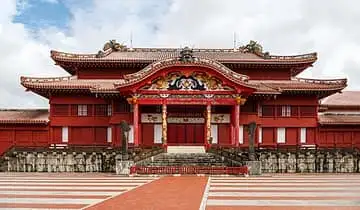
Shuri Castle. (1986 vs 1429) Shuri Castle →
Nearby on the globe





Sources
Updated: 2026-10-14