
Lungshan Temple of Manka
룽산쓰
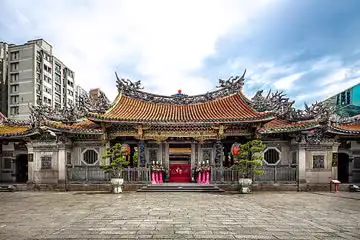
Bangka Lungshan Temple, also called Longshan Temple of Manka, is a busy temple in the Wanhua District of Taipei, Taiwan. Settlers from Fujian, a province on the southeast coast of China, built it in 1738 to honor Guanyin, a Buddhist figure known for compassion. It was a place of worship and a gathering place for the new settlers.
See it on the 3D globe →At a glance
- Country
- Taiwan
- Location
- Taipei, Taiwan
- Built
- 1738
- Type
- Religious building
Quick answers
Where is Lungshan Temple of Manka?
Lungshan Temple of Manka is in Taipei, Taiwan.
When was Lungshan Temple of Manka built?
Lungshan Temple of Manka was built in 1738.
One of Taipei's oldest temples (1738), with swallowtail ridges and dragons of cut porcelain on its roofs.
Today it is still a place where neighbors come to pray, and one of Taipei's best-known historic buildings. Along with Buddhist halls, it has altars to Chinese folk gods such as Mazu, who protects sailors, and Guan Yu, a famous warrior. Its roofs, with curling swallowtail ridges and bright dragons made of cut porcelain, make it easy to spot among the nearby buildings.
Where the name comes from
The name comes from an old Longshan Temple in Jinjiang county in Fujian. Settlers from three Fujian counties, Jinjiang, Nan'an and Hui'an, came to the Manka area in the early 1700s. They were devoted followers of that temple back home, so they built a branch temple here and gave it the same name when they created their new settlement in Taipei.
Rebuilt again and again
The temple you see now is not the building from 1738. It was rebuilt between 1919 and 1924. Earthquakes and fires have destroyed all or part of it many times, and the people of Taipei kept rebuilding it. On 31 May 1945, in World War II, American bombers hit it because Japanese forces were reportedly hiding weapons there. The main building and left corridor were damaged and many treasures were lost, but it was repaired after the war.
How people pray here
Visitors enter through the Dragon Gate and leave by the Tiger Gate, taking care not to step on the threshold. Prayers go in order: first the front hall, then the main hall with the central Guanyin statue, and then the rear hall, where each deity helps with something different. A well-known one is Yue Lao, who is asked for help with love. Worshippers also toss crescent-shaped wooden blocks called jiaobei to ask questions.
Fun facts
- Built by settlers from Fujian in 1738, it has been rebuilt after earthquakes, fires and a wartime bombing.
- Visitors enter by the Dragon Gate and leave by the Tiger Gate.
- The rear hall includes a deity of medicine, one of exams, and one of love.
- Red threads from the Yue Lao altar are given away for free.
- The temple is a short walk from Longshan Temple Station on the Taipei Metro.
On the globe
The model shows the temple with its swallowtail roof ridges and colorful dragon decorations. Zoom in to look at the curling rooflines.
Quiz time
Which is older: Lungshan Temple of Manka or Gyeongbokgung Palace?
Show the answer
Gyeongbokgung Palace. (1738 vs 1395) Gyeongbokgung Palace →
Nearby on the globe

Sources
Updated: 2026-10-14