
Flag of Suriname
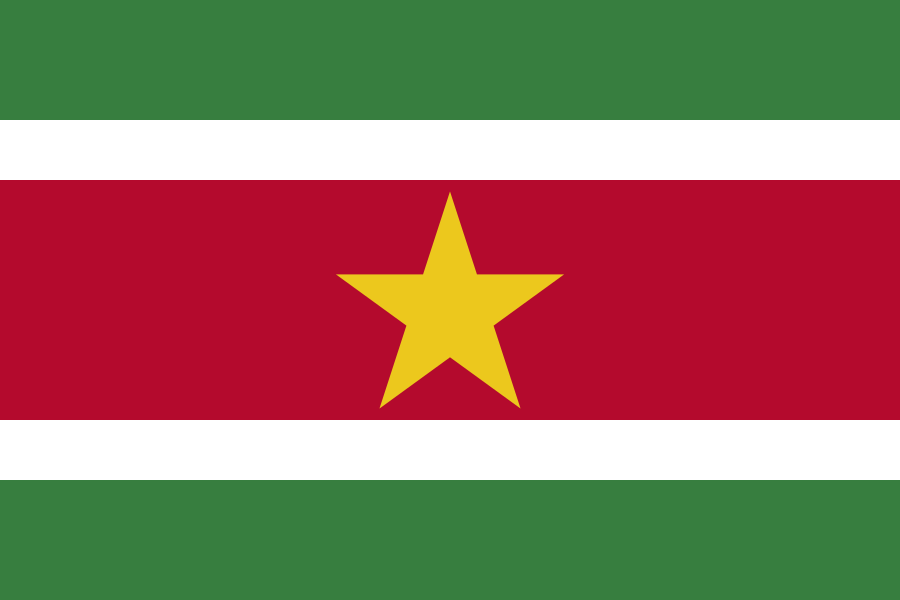
Five horizontal stripes of green, white, red, white and green, with a wide red stripe in the middle holding a yellow five-pointed star.
At a glance
- Adopted
- November 25, 1975
- Shape (height : width)
- 2:3
- Capital
- Paramaribo
- Continent
- South America
- Colours
- green
- white
- red
- yellow
What it means
- Green: the fertile land and a hopeful new start
- White: justice and freedom
- Red: progress and renewal, and love that leads to action
- Yellow star: national unity, with all groups together under one star, and a golden future built on sacrifice
Where it came from
The flag came from a national design contest held just before independence. The winner was Jack (Jacques Herman) Pinas, an art teacher and graphic designer, and some changes were made to his entry before it was adopted.
The stripes have fixed widths: 2, 1, 4, 1 and 2 parts from top to bottom.
History
From 1959, when Suriname was a Dutch territory, its flag was white with five coloured stars joined by a black oval. It was designed by Noni Lichtveld. The stars stood for the main ethnic groups and the oval for living together in harmony.
Many people felt that flag drew attention to differences between groups, so at independence on 25 November 1975 it was replaced by today's single-star flag. It stayed the same after the military coup of 1980.
Fun facts
- The old flag had five stars; the new one has just one, to show that everyone belongs together.
- The official rules give paint recipes for the colours, such as 9 parts chromate green to 1 part white.
- The red middle stripe is four times as tall as each white stripe.
- The designer was an art teacher who won a national contest.
Questions
What does the flag of Suriname look like?
Five horizontal stripes of green, white, red, white and green, with a wide red stripe in the middle holding a yellow five-pointed star.
What do the colours and symbols on the flag of Suriname mean?
Green: the fertile land and a hopeful new start; White: justice and freedom; Red: progress and renewal, and love that leads to action; Yellow star: national unity, with all groups together under one star, and a golden future built on sacrifice.
When was the flag of Suriname adopted?
The current flag of Suriname was adopted on November 25, 1975.
What colours are on the flag of Suriname?
The flag of Suriname uses green, white, red and yellow.
Famous landmarks in Suriname

🎯 Play the flag quiz 🌍 Play the globe
Sources
- en.wikipedia.org
- crwflags.com
- Flag picture: flagcdn.com (Wikimedia Commons)