
Amazon Rainforest
아마존 열대우림
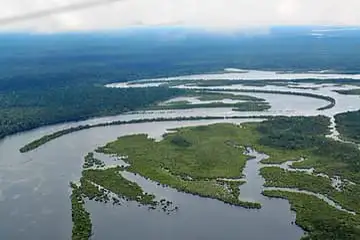
The Amazon rainforest, also called Amazonia, is a moist broadleaf tropical rainforest that covers most of the Amazon basin of South America. The basin spans 7 million square kilometres, of which 6 million are covered by rainforest. Territory from nine nations and 3,344 indigenous territories lies within it. About 60 percent of the forest is in Brazil, 13 percent in Peru and 10 percent in Colombia, with smaller parts in Bolivia, Ecuador, French Guiana, Guyana, Suriname and Venezuela.
See it on the 3D globe →At a glance
- Country
- Brazil
- Location
- Amazon Basin, South America
Quick answers
Where is Amazon Rainforest?
Amazon Rainforest is in Amazon Basin, South America, Brazil.
The largest tropical rainforest on Earth, home to an unrivalled diversity of plants and animals.
It makes up over half of the world's remaining rainforest and is the largest and most biodiverse tract of tropical rainforest on Earth, with an estimated 390 billion trees of about 16,000 species. More than 30 million people from 350 ethnic groups live in the Amazon, and about 60 groups remain largely isolated.
A forest shaped by people
Humans first settled the Amazon region at least 11,200 years ago, based on finds at the Caverna da Pedra Pintada. For a long time scientists thought poor soil could never feed many people, but new findings suggest the region was densely populated, perhaps 5 million people in AD 1500. Dark fertile soil called terra preta, now widely seen as made by indigenous soil management, and large geoglyphs, earthworks found since the 1970s, suggest that much of the forest was shaped by people over centuries. In 2003 researchers found roads, bridges and plazas in the Xingu region.
The name and the first explorers
Francisco de Orellana was the first European to travel the length of the Amazon River, in 1542. The name Amazon is said to come from a war he fought with the Tapuyas and other tribes, in which women fought alongside the men. He linked them to the Amazons of Greek mythology. The British explorer Percy Fawcett searched for a lost civilisation he called the City of Z and disappeared mysteriously on his last trip.
A forest under pressure
The Amazon formed likely during the Eocene era, between 56 and 33.9 million years ago. Large-scale deforestation is happening today and causes harmful effects. Economic losses from deforestation in Brazil could be about seven times higher than the value of the goods produced by it. In 2023 the World Bank proposed an economic programme for the region that does not rely on cutting down forest. Four nations use Amazonas as the name of a first-level region.
Fun facts
- It covers more than 5 million km² across nine countries and territories.
- The Amazon holds an estimated 390 billion trees of about 16,000 species.
- More than 30 million people of 350 ethnic groups live there.
- Terra preta, a dark fertile soil, is widely seen as made by people.
- Four countries use Amazonas as the name of a region.
On the globe
The model shows dense green forest with a winding river. Look for the river curving through the trees.
Nearby on the globe
.jpg)
Sources
Updated: 2026-10-14