
Vinicunca (Rainbow Mountain)
비니쿤카 (무지개산)
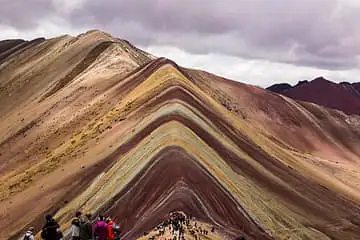
Vinicunca, often called Rainbow Mountain, is a peak in the Andes of Peru's Cusco Region, southeast of the city of Cusco. Its slopes are painted in stripes of red, pink, white, green, brown and mustard yellow, which makes it one of the most photographed mountains in South America.
See it on the 3D globe →At a glance
- Country
- Peru
- Location
- Cusco Region, Peru
- Height
- 5,036 m
- Type
- Mountain
Quick answers
Where is Vinicunca (Rainbow Mountain)?
Vinicunca (Rainbow Mountain) is in Cusco Region, Peru.
A 5,036 m Andean peak striped by colourful mineral layers, nicknamed Rainbow Mountain.
The colors are not paint or plants. They come from different minerals in the rock layers, which were pushed up and tilted over a very long time. The summit is about 5,036 m above sea level according to Wikipedia, although other sources give about 5,200 m, so the air is thin and visitors need time to get used to the altitude.
Why is Vinicunca so colorful?
The stripes are layers of different minerals. Red clay and sand give pink tones, quartz and calcium-rich sandstone look white, iron-bearing claystone is red, iron and magnesium clays turn green, conglomerate is brown, and sulfur-bearing sandstone looks mustard yellow. Over time the layers were folded and lifted until they stood on edge, so you can see them as bands across the hillside. Glaciers once covered the area, and the ice caps melted in 2013, which helped reveal the colors.
Visiting and protecting the mountain
Most visitors drive about two hours from Cusco and then walk roughly 5 km on a steep path. Mass tourism began in the mid-2010s. In 2015 a mining company asked for rights to explore about 400 hectares that included the mountain, but after public protests it gave up the concession in 2018. Peru then paused new mining for a year, and the Ausangate area became a Regional Conservation Area in 2019.
Fun facts
- The mountain has several names, including Winikunka and Montaña de Siete Colores, meaning Mountain of Seven Colors.
- Its ice caps melted in 2013, and tourists started arriving in large numbers only a few years later.
- The stripes are caused by minerals such as iron and sulfur compounds, not by paint or plants.
On the globe
The globe model shows the Andean peak with its bands of mineral colors. Look for the red, yellow and green stripes running across the slope.
Nearby on the globe

Sources
Updated: 2026-10-14