
Aqueduct of Segovia
세고비아 수도교
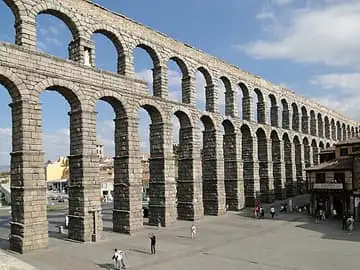
The Aqueduct of Segovia is a Roman bridge-like structure that carried water into the city of Segovia in Spain. At its tallest it is 28.5 metres high, and its complete arcade has 167 arches, in one and two tiers. It is one of the best-preserved Roman aqueduct bridges and the foremost symbol of Segovia, appearing on the city's coat of arms.
See it on the 3D globe →At a glance
- Country
- Spain
- Location
- Segovia, Spain
- Built
- 100
- Height
- 28 m
- Type
- Infrastructure
Quick answers
Where is Aqueduct of Segovia?
Aqueduct of Segovia is in Segovia, Spain.
When was Aqueduct of Segovia built?
Aqueduct of Segovia was built in 100.
How tall is Aqueduct of Segovia?
Aqueduct of Segovia is about 28 m tall.
A Roman aqueduct of granite blocks laid without mortar, its two tiers of arches striding across the city.
It was built around the 1st century AD, though evidence published in 2016 points to a date after the year 112. The blocks are granite, laid without any mortar or cement, and gravity holds them together. It brought water from the mountains to fountains, baths and houses until 1973. UNESCO listed it with the Old Town of Segovia in 1985.
How the water travelled
The water came from the Río Frío in the mountains, about 17 km away, and the channel runs about 15 km before reaching the city. Builders followed the rules of the Roman writer Vitruvius. The water was gathered in a tank called El Caserón, then moved to a second house, the Casa de Aguas, where sand could settle out.
From there it flowed down a very gentle slope of about one percent to the rocky hill where the walled city stands. The final stretch crossed the valley on the arches.
A mystery of dates
The aqueduct has no readable inscription. A dedication plaque in the top of the structure once had bronze letters, now missing. At the end of the 20th century the scholar Géza Alföldy studied the anchor holes and decided that Emperor Domitian ordered it, proposing 98 AD as the likely completion.
Then in 2016 new archaeological evidence suggested a slightly later date, during the rule of Trajan or the start of Hadrian's rule, after 112 AD.
Still standing
The Moors destroyed part of the aqueduct in 1072, and in the 15th century 36 arches were rebuilt under King Ferdinand and Queen Isabella, with great care to keep the original style. In the 16th century statues were placed in the central niches. On the top of the tallest arches the niche that once held Hercules, the legendary founder of the city, now holds the Virgin.
It kept supplying Segovia with water until 1973. Stone decay and pollution later put it on the 2006 World Monuments Watch, and a restoration project followed.
Fun facts
- Its granite blocks hold together without any mortar, and it appears on Segovia's coat of arms.
- It has 167 arches and no mortar.
- It carried water for nearly 1,900 years, until 1973.
- The designers followed rules from the Roman writer Vitruvius.
- Coins made in Segovia once showed the aqueduct as a mint mark.
On the globe
The model shows the long granite arches striding across the town. Look for the double row of arches in the tallest part.
Quiz time
Which is taller: Aqueduct of Segovia or Cuatro Torres Business Area?
Show the answer
Cuatro Torres Business Area. (28 m vs 249 m) Cuatro Torres Business Area →
Nearby on the globe



Sources
Updated: 2026-10-14