
Real Casa de Correos
레알 카사 데 코레오스 (킬로미터 제로)
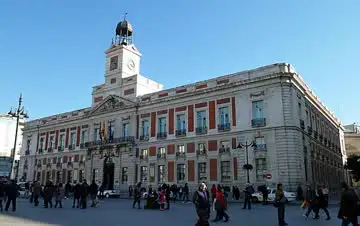
An 18th-century building on the Puerta del Sol; the Kilómetro Cero plaque marking the origin of Spain's radial roads lies in front, and its clock rings in the New Year.
See it on the 3D globe →At a glance
- Country
- Spain
- Location
- Madrid, Spain
- Built
- 1768
- Type
- Government building
Quick answers
Where is Real Casa de Correos?
Real Casa de Correos is in Madrid, Spain.
When was Real Casa de Correos built?
Real Casa de Correos was built in 1768.
The Real Casa de Correos, or Royal House of the Post Office, is an 18th-century building on the southern side of Madrid's Puerta del Sol square. It was built for the postal service, and today it is the office of the President of the Community of Madrid, the head of the regional government. It is the oldest building on the Puerta del Sol.
Its best-known feature is a small clock tower on the roof. Once a year, on New Year's Eve, the whole country watches that clock. A plaque on the ground in front of the main door, called Kilómetro Cero, marks kilometer 0 of the streets of Madrid and of Spain's main roads.
How it came to be
In the 1600s about thirty two-storey houses stood here. In the 1750s the area was cleared as part of shaping the Puerta del Sol. The idea of a post office there came from the Marquis of Ensenada around 1750, and the architect Ventura Rodríguez drew plans between 1756 and 1760.
When Charles III became king in 1759 the French architect Jacques Marquet took charge of the building instead, and work began in the late 1760s. A smaller building behind it, the Casa de Postas, was added around 1795.
A busy and sometimes dark past
For a time a tower on the roof was the end of one of Spain's optical telegraph lines, which sent messages by signals seen from tower to tower. Later the building was the headquarters of the Ministry of the Interior and State Security under Franco. Its basement was infamous as a place where people who opposed the regime were tortured. Today it is a government office.
The clock and the grapes
The clock on the roof was inaugurated in 1866 by Queen Isabel II. Its time ball and bells mark the Twelve Grapes tradition: as midnight strikes on New Year's Eve, Spaniards eat one grape for each bell stroke.
The change of year is broadcast from here on national television and radio. Television broadcasts of it began in 1962 on Televisión Española.
Fun facts
- The Kilómetro Cero plaque in front of it marks the starting point of Spain's national roads.
- The Kilómetro Cero plaque in front is where Spain's radial roads and Madrid's street numbers begin.
- Spaniards eat twelve grapes at midnight as the clock strikes.
- A tower on its roof once ended an optical telegraph line.
- It is the oldest building on the Puerta del Sol.
On the globe
The model shows the old post office building with its clock tower on the Puerta del Sol.
Quiz time
Which is older: Real Casa de Correos or Aqueduct of Segovia?
Show the answer
Aqueduct of Segovia. (1768 vs 100) Aqueduct of Segovia →
Nearby on the globe
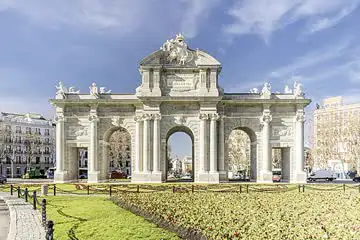
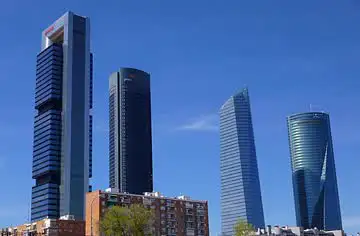
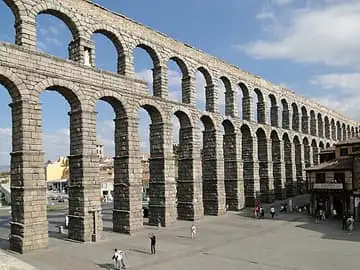
_05b.jpg)
Sources
- Read more on Wikipedia
- Royal House of the Post Office — Wikipedia
- Real Casa de Correos — Wikipedia (Spanish)
Updated: 2026-10-14