
Baalbek
바알베크
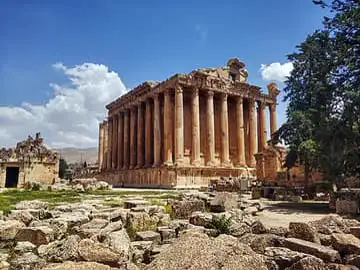
Baalbek is a town in the Beqaa Valley of Lebanon, about 1,170 metres above sea level and northeast of the capital, Beirut. It is home to some of the largest and best-preserved Roman temple ruins anywhere in the world.
See it on the 3D globe →At a glance
- Country
- Lebanon
- Location
- Beqaa Valley, Lebanon
- Built
- 1st c. BC
- Height
- 20 m
- Type
- Ancient site
Quick answers
Where is Baalbek?
Baalbek is in Beqaa Valley, Lebanon.
How tall is Baalbek?
Baalbek is about 20 m tall.
Monumental Roman temple ruins, including one of the best-preserved Roman temples, to Bacchus.
People have lived here for thousands of years. After Alexander the Great conquered the area, the town was renamed Heliopolis, which means "City of the Sun" in Greek. Later the Romans turned it into one of the great religious centres of their empire, building a temple complex over about three centuries, from the late 1st century BC onwards. The site includes a huge temple to Jupiter, an outstanding temple to Bacchus, the god of wine, and a small round temple to Venus. UNESCO listed Baalbek as a World Heritage Site in 1984, calling it one of the finest examples of Roman imperial architecture.
The temples
The Temple of Jupiter was among the largest temples the Romans ever built. It was once surrounded by 54 tall Corinthian columns, but earthquakes and later demolition brought most of them down: only six still stand today, carrying stone blocks about 19 metres above the ground. Next to it, the Temple of Bacchus is the best-preserved building on the site. It is surrounded by 42 columns nearly 20 metres tall and is even larger than the Parthenon in Athens.
Giant stones
Baalbek is famous for its enormous building blocks. Part of the Jupiter temple's base, called the Trilithon, is made of three limestone blocks, each more than 19 metres long and weighing around 800 tonnes. In an ancient quarry nearby lies an even bigger block called the Stone of the Pregnant Woman, estimated at about 1,000 tonnes. In 2014 archaeologists found another one beside it, thought to weigh about 1,650 tonnes. Researchers think the Romans moved such blocks with rollers, ropes, pulleys and hundreds of workers.
Baalbek through time
Earthquakes struck the town many times, including three in the 12th century and more in 1759, and toppled many columns: in the 16th century 27 columns of the Jupiter temple still stood, and only nine were left before 1759. When Christianity spread, the round temple of Venus was replaced by a church, while other temples survived partly because they were reused as churches. Today the ruins are the setting of the long-running Baalbek International Festival, held among the ancient columns.
Fun facts
- Its quarry holds some of the largest stone blocks ever cut, weighing around 1,000 tonnes.
- Heliopolis, Baalbek's old Greek name, means "City of the Sun".
- Only 6 of the 54 columns of the Temple of Jupiter are still standing.
- Each of the three Trilithon blocks is longer than 19 metres and weighs around 800 tonnes.
- A stone block found in the quarry in 2014 is thought to weigh about 1,650 tonnes.
On the globe
The model shows monumental Roman temple ruins in Lebanon's Beqaa Valley, including the well-preserved Temple of Bacchus. Zoom in east of the Mediterranean coast to find its tall columns.
Quiz time
Which is taller: Baalbek or Umayyad Mosque?
Show the answer
Umayyad Mosque. (20 m vs 77 m) Umayyad Mosque →
Nearby on the globe



.jpg)
Sources
Updated: 2026-10-13