
Krak des Chevaliers
크락 데 슈발리에
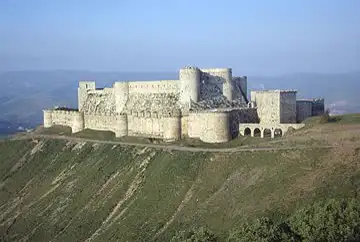
Krak des Chevaliers is one of the best-preserved medieval castles in the world. It sits on a hill in western Syria, about 40 kilometers west of the city of Homs and not far from the border with Lebanon. It was rebuilt and enlarged by a Christian military order, the Knights Hospitaller, during the Crusades, and today it is a UNESCO World Heritage Site.
See it on the 3D globe →At a glance
- Country
- Syria
- Location
- near Homs, Syria
- Built
- 1031; enlarged 1142–1271
- Type
- Castle
Quick answers
Where is Krak des Chevaliers?
Krak des Chevaliers is in near Homs, Syria.
The finest surviving Crusader castle, enlarged by the Knights Hospitaller with concentric walls and a massive talus.
The name comes from the Syriac word karak, meaning a walled fortress. Before the knights came, a local ruler had settled Kurdish soldiers there, so the Arabs called it the "fort of the Kurds". The French name Krak des Chevaliers, "fortress of the knights", became popular in the 1800s.
History
In 1031 the emir of Aleppo and Homs placed Kurdish tribesmen at the site. In 1142 the Count of Tripoli handed the place to the Hospitallers, who spent the 1140s onward rebuilding it into a mighty castle; an earthquake damaged it in 1170. In 1271 the Mamluk sultan Baibars arrived with his army, and the knights eventually gave up the castle.
Why it is so strong
The Hospitallers added tall, thick walls in rings, one inside the other, so attackers had to break through several lines of defense. A steep, sloping base, called a talus, made the walls hard to climb or undermine. After the Crusader age, people lived inside until 1933, when about 500 residents were moved out so the castle could be cared for. Today the village of al-Husn lies around it.
Fun facts
- T. E. Lawrence called it perhaps the best-preserved and most admirable castle in the world.
- The castle's Arabic name, Hisn al-Akrad, means the "fort of the Kurds".
- About 500 people lived inside the castle until 1933.
On the globe
The model shows the hilltop castle with its double ring of walls and sloping base; look for the strong fortress on the hill.
Nearby on the globe


Sources
Updated: 2026-10-14