
Bank of China Tower
중국은행 타워
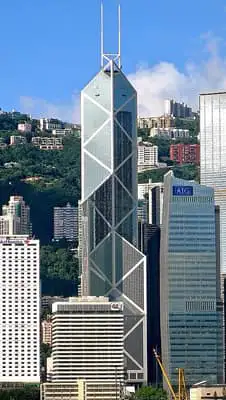
The Bank of China Tower is a skyscraper at 1 Garden Road in Central, on Hong Kong Island. It is the headquarters of the Bank of China (Hong Kong) and one of the most recognisable buildings in the city, thanks to its sharp, angled shape made of triangles covered in glass. It was designed by the Chinese-American architect I. M. Pei, winner of the Pritzker Prize, one of the top awards in architecture, together with L. C. Pei.
See it on the 3D globe →At a glance
- Country
- Hong Kong SAR China
- Location
- Hong Kong
- Built
- 1990
- Height
- 367 m
- Type
- Skyscraper
Quick answers
Where is Bank of China Tower?
Bank of China Tower is in Hong Kong, Hong Kong SAR China.
When was Bank of China Tower built?
Bank of China Tower was built in 1990.
How tall is Bank of China Tower?
Bank of China Tower is about 367 m tall.
I. M. Pei's angular skyscraper of triangular frameworks, a defining piece of Hong Kong's skyline.
The tower is 315 metres tall to its roof, and two masts on top bring it to 367.4 metres. It has 72 storeys and was completed in 1990. When it opened it was the tallest building in Hong Kong and in all of Asia, and it was the first building outside the United States to rise above 305 metres, or 1,000 feet. Other towers have since passed it, but it is still one of Hong Kong's tallest.
A tower made of triangles
The building starts as a square block at the bottom. Imagine that square split into four triangles, like a sandwich cut corner to corner. Each triangle becomes a tall glass shaft, and the shafts stop at different heights, so as the tower climbs it gets narrower until only one triangle is left at the top. Pei is said to have been inspired by bamboo, which grows upward in sections. Diagonal steel braces carry the building's weight out to four big steel columns at the corners. This clever frame helped the tower stand up to strong typhoon winds while saving time and building materials.
History
The site was once home to Murray House, an old building that was taken apart brick by brick and rebuilt in Stanley, on the south side of Hong Kong Island. Construction began in 1985 and was carried out by the Japanese company Kumagai Gumi. The bank had hoped to finish on 8 August 1988, a date with lucky eights, but the project ran late. The tower was topped out in 1989, and people moved in on 15 June 1990. The structural engineer was Leslie E. Robertson, who also engineered New York's original World Trade Center towers.
Why some people worried
In Hong Kong, many builders ask feng shui masters for advice. Feng shui is a traditional Chinese practice about arranging buildings and spaces in harmony with their surroundings. The Bank of China Tower was unusual because it was designed without that advice. Some critics said its sharp edges and the many X shapes on its sides were unlucky, and Pei changed the design a little in response. From some angles the building looks like a giant meat cleaver, so it earned the Cantonese nickname meaning "one knife".
Fun facts
- Designed by I. M. Pei, it was the first building outside the United States to pass 305 m.
- The old building that stood on the site, Murray House, was taken apart and rebuilt brick by brick in Stanley.
- The tower was the first skyscraper in the world built with a composite space frame, a 3D framework of steel and concrete.
- It has appeared in many films and games, including Godzilla vs. Kong, where it survives the monsters' battle in Hong Kong.
- The bank uses the top four floors and the bottom 19 floors, and rents the floors in between to other companies.
On the globe
The model shows I. M. Pei's angular skyscraper made of triangular frameworks in Hong Kong. Zoom in to see how the triangles step back as the tower rises to its two masts.
Quiz time
Which is taller: Bank of China Tower or Lippo Centre?
Show the answer
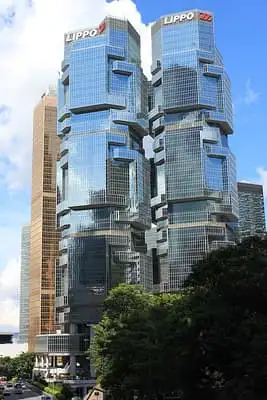
Bank of China Tower. (367 m vs 186 m) Lippo Centre →
Nearby on the globe
.jpg)
Sources
- Read more on Wikipedia
- Bank of China Tower (Hong Kong) — Wikipedia
- 중국은행 타워 (홍콩) — 위키백과
- Bank of China Tower — Pei Cobb Freed & Partners
- Bank of China Tower — A View On Cities
Updated: 2026-10-13