
Blue Mosque, Mazar-i-Sharif
마자르이샤리프 블루 모스크
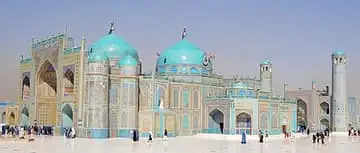
The Shrine of Hazrat Ali that gave Mazar-i-Sharif (“the noble shrine”) its name: a 15th-century Timurid shrine clad in blue and turquoise tiles under ribbed domes, famous for the white doves on its marble court.
See it on the 3D globe →At a glance
- Country
- Afghanistan
- Location
- Mazar-i-Sharif, Afghanistan
- Built
- 15th c.
- Type
- Religious building
Quick answers
Where is Blue Mosque, Mazar-i-Sharif?
Blue Mosque, Mazar-i-Sharif is in Mazar-i-Sharif, Afghanistan.
The Shrine of Hazrat Ali, also known as the Mausoleum of Imam Ali or the Blue Mosque, is a mosque and shrine complex in the middle of Mazar-i-Sharif, the capital and largest city of Balkh Province in northern Afghanistan. It is said to hold the tomb of Caliph Ali, the first Imam of Shia Muslims, though this is a matter of belief. The city's name, meaning noble shrine, is thought to come from it.
Blue and turquoise tiles cover the shrine, which is topped with ribbed domes. It is a popular attraction visited all year by people regardless of religion or sect, and its white marble courtyard is famous for the doves that gather there. Many pilgrims come every year to celebrate Nowruz, the New Year.
A shrine built, destroyed and rebuilt
The earliest surviving text that says Ali is buried in Balkh is from the traveller Abu Hamid al-Gharnati, who died in 1170. The first structure was a shrine built by the Seljuk sultan Ahmad Sanjar in 1136. The Mongols under Genghis Khan destroyed it in 1220, because they believed treasure lay beneath it. In the 15th century the Timurid ruler Sultan Husayn Bayqara ordered a reconstruction, which became the present Blue Mosque.
Later repairs
Over the years other rulers repaired the shrine and gave money to it. A Shaybanid emir built a dome, and Berdi Beg, the Khan of the Golden Horde from 1357 to 1359, added decoration. A plan to renovate the whole complex was made in 1910. Sher Ali Khan, Emir of Afghanistan in the 1860s, and some of his relatives are buried at the site. In the 2025 Balkh earthquake the minaret was partly damaged and cracks formed in the walls.
Flag and festival
At the yearly Janda Bala ceremony, a flag used to be raised in honour of Ali, and pilgrims touched it hoping for good luck in the New Year. This ceremony has been officially stopped in recent years.
Fun facts
- It is famous for the white doves that flock around the shrine.
- The city of Mazar-i-Sharif is named after the shrine.
- The Mongols destroyed the first shrine in 1220 hoping to find treasure.
- Pilgrims celebrate Nowruz, the New Year, here.
- A 2025 earthquake damaged the minaret.
On the globe
The model shows the blue-tiled shrine with its ribbed domes and the marble courtyard. Look for the white doves.
Nearby on the globe

Sources
Updated: 2026-10-14