
Gur-e-Amir
구르에미르
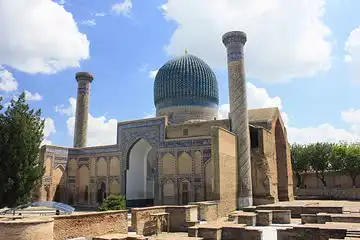
Gur-e-Amir is the tomb of the Turco-Mongol conqueror Timur, also known as Tamerlane, in Samarkand, Uzbekistan. Its Persian name means "Tomb of the King." It is crowned by an azure, ribbed dome, and it holds the graves of Timur, his sons and his grandsons.
See it on the 3D globe →At a glance
- Country
- Uzbekistan
- Location
- Samarkand, Uzbekistan
- Built
- 1404
- Type
- Monument
Quick answers
Where is Gur-e-Amir?
Gur-e-Amir is in Samarkand, Uzbekistan.
When was Gur-e-Amir built?
Gur-e-Amir was built in 1404.
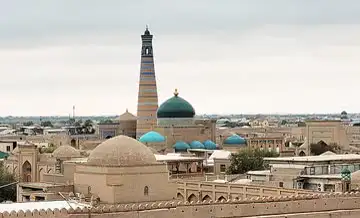
The mausoleum of Timur, crowned by a ribbed turquoise dome on a tall drum banded with giant Kufic script.
It matters in architectural history because its design came before, and influenced, the later Mughal tombs, including Humayun's Tomb in Delhi and the Taj Mahal in Agra, built by Timur's descendants. It has been heavily restored over the years. The mausoleum is an octagonal building set in a complex that once had a madrasah and a khanqah, a religious school and a hostel for travellers; only their foundations, an entrance portal and part of a minaret survive.
Built for a grandson, used for a king
The earliest part of the complex was built at the end of the 14th century on the orders of Muhammad Sultan, Timur's heir and beloved grandson. The mausoleum itself began in 1403 after Muhammad Sultan died suddenly. Timur had planned a smaller tomb for himself at Shahrisabz, but when he died in 1405 on a campaign toward China, the mountain passes were blocked by snow, so he was buried here instead. His grandson Ulugh Beg finished the work.
Blue tiles and a ribbed dome
Outside, Gur-e-Amir is a one-dome building known for its simple form and solemn grandeur. The walls are decorated with blue, light-blue and white tiles that form geometric and lettered patterns against a terracotta brick background. The ribbed dome is a bright blue, about 15 metres across, and its heavy fluting gives it a striking look. The dome is about 12.5 metres high and its deep ribs give it a striking, almost sculpted look.
Fun facts
- Its design influenced later Mughal tombs such as the Taj Mahal.
- Timur had a smaller tomb prepared elsewhere, but snow-blocked passes meant he was buried here.
- The tomb also holds Timur's teacher, Sayyid Baraka.
On the globe
The model shows the turquoise ribbed dome on its tall drum, banded with giant Kufic script.
Quiz time
Which is older: Gur-e-Amir or Registan, Samarkand?
Show the answer
Gur-e-Amir. (1404 vs 1660) Registan, Samarkand →
Nearby on the globe


Sources
Updated: 2026-10-14