
Brandenburg Gate
브란덴부르크 문
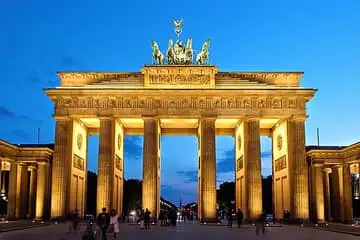
The Brandenburg Gate is a large stone gateway in the centre of Berlin, the capital of Germany. King Frederick William II of Prussia had it built between 1788 and 1791 to mark the grand entrance to Unter den Linden, the city's famous tree-lined avenue. The architect, Carl Gotthard Langhans, copied ideas from the Propylaea, the ancient entrance gate to the Acropolis in Athens.
See it on the 3D globe →At a glance
- Country
- Germany
- Location
- Berlin, Germany
- Built
- 1791
- Height
- 26 m
- Type
- Monument
Quick answers
Where is Brandenburg Gate?
Brandenburg Gate is in Berlin, Germany.
When was Brandenburg Gate built?
Brandenburg Gate was built in 1791.
How tall is Brandenburg Gate?
Brandenburg Gate is about 26 m tall.
A neoclassical triumphal gate that went from Cold War divide to the emblem of German reunification.
The gate is about 26 metres tall and 62.5 metres wide. Twelve Doric columns, six on each side, create five passageways, and on top stands the Quadriga, a statue of a goddess driving a chariot pulled by four horses. For almost 30 years the Berlin Wall ran right beside the gate and nobody could walk through it. Today it is a symbol of German reunification and of peace in Europe.
History
The gate was first called the Peace Gate and opened to traffic in 1791. In 1806 the French emperor Napoleon defeated Prussia, marched through the gate and carried the Quadriga off to Paris. It came back in 1814, and the goddess was turned into Victoria, the Roman goddess of victory. The gate survived World War II full of bullet holes. In 1961 the Berlin Wall was built right next to it, cutting East Berlin off from West Berlin. On 22 December 1989 the crossing reopened as the leaders of West and East Germany walked through together.
The Quadriga on top
The Quadriga was made by the sculptor Johann Gottfried Schadow and placed on the gate in 1793. A quadriga is a chariot pulled by four horses running side by side. The statue was hammered from thin copper sheets pressed into moulds, which turned out to be lucky: the moulds were kept, so the statue could be rebuilt after war damage. Only one horse's head from the original survived World War II, and it is kept in a Berlin museum. The chariot faces east, into the old city centre.
Visiting today
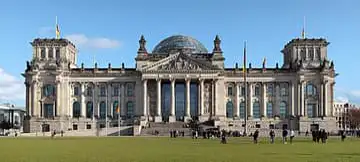
Cars no longer drive through the gate. The square in front of it, Pariser Platz, is a cobbled area for people on foot, and the German parliament building, the Reichstag, is just a block away. The wide avenue to the west can hold huge crowds, so Berlin uses it for New Year's Eve fireworks, concerts and big celebrations. The Berlin Marathon usually finishes here, and in 2014 the German football team celebrated its World Cup win in front of the gate.
Fun facts
- The Quadriga, a chariot drawn by four horses, stands on top.
- Napoleon took the four-horse statue from the top of the gate to Paris as a war prize, and Prussia brought it home eight years later.
- From 1814 to 1919 only the royal family, and a few special guests, were allowed to use the middle passage.
- During World War II a fake copy of the gate was built away from the city centre to confuse bomber pilots.
- In 2009, more than 1,000 giant foam dominoes were toppled along the old line of the Berlin Wall, ending at the gate.
On the globe
The model shows the neoclassical gate in Berlin with its row of columns and the four-horse Quadriga on top. Zoom in to spot the chariot sitting above the passageways.
Quiz time
Which is taller: Brandenburg Gate or Reichstag Building?
Show the answer
Reichstag Building. (26 m vs 47 m) Reichstag Building →
Nearby on the globe

Sources
- Read more on Wikipedia
- Brandenburg Gate — Wikipedia
- 브란덴부르크 문 — 위키백과
- Brandenburg Gate — Berlin.de, the official website of Berlin
Updated: 2026-10-13