
Church of the Savior on Spilled Blood
피의 구세주 성당
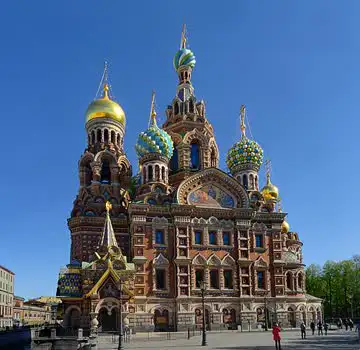
The Church of the Savior on Spilled Blood is a colourful Russian Orthodox church in Saint Petersburg, Russia. Its official name is the Church of the Resurrection of Christ. It stands beside the Griboyedov Canal, on the exact spot where Emperor Alexander II was attacked and fatally wounded in March 1881, and the words on Spilled Blood refer to that attack.
See it on the 3D globe →At a glance
- Country
- Russia
- Location
- Saint Petersburg, Russia
- Built
- 1907
- Height
- 81 m
- Type
- Religious building
Quick answers
Where is Church of the Savior on Spilled Blood?
Church of the Savior on Spilled Blood is in Saint Petersburg, Russia.
When was Church of the Savior on Spilled Blood built?
Church of the Savior on Spilled Blood was built in 1907.
How tall is Church of the Savior on Spilled Blood?
Church of the Savior on Spilled Blood is about 81 m tall.
Built where Alexander II was assassinated, with patterned onion domes and walls of mosaic inside.
His son, Emperor Alexander III, ordered the church as a memorial, and it was built between 1883 and 1907, mostly with money from the royal family and private donors. Most buildings in Saint Petersburg are in Baroque or Neoclassical style, but this church deliberately looks like old Russian churches, with twisted, patterned onion domes similar to St Basil's Cathedral in Moscow. Inside, almost every wall and ceiling is covered in mosaics, and today it works mainly as a museum.
Why it was built here
On 13 March 1881 (1 March in the old Russian calendar), Alexander II's carriage was driving along the canal when a bomb thrown by a revolutionary group exploded. The emperor got out unhurt, but a second attacker threw another bomb that wounded him badly, and he died a few hours later in the Winter Palace. To build the church on the exact spot, part of the canal was narrowed so that the stretch of road could fit inside the church walls. A shrine now marks the place, and the old cobblestones of the road can still be seen in its floor.
The mosaics
The church holds about 7,000 square metres of mosaics, pictures made from thousands of tiny pieces of coloured glass and stone. Saint Petersburg's official visitor guide describes it as one of the largest collections of monumental mosaic in Europe. Famous Russian artists of the time, including Viktor Vasnetsov, Mikhail Nesterov and Mikhail Vrubel, designed the artwork, which shows Bible stories and holy figures framed by finely patterned borders.
Hard times and a long restoration
After the Russian Revolution of 1917 the church was looted, and the Soviet government closed it in 1932. During the Second World War, when Leningrad (as the city was then called) was surrounded and many people starved, it was used as a temporary morgue. After the war it became a warehouse for vegetables, which earned it the joking nickname Savior on Potatoes. In 1970 it was handed to the museum of St Isaac's Cathedral; restoration took 27 years, and the church reopened to visitors in August 1997.
Fun facts
- Its walls are covered with more than 7,000 m² of mosaics.
- The central tower is 81 metres tall, a number chosen to recall 1881, the year Alexander II died.
- Another dome is 63 metres tall, matching the emperor's age when he died.
- Part of the canal was made narrower so the spot where the emperor was attacked could fit inside the church.
- After World War II the church was used to store vegetables, so people nicknamed it Savior on Potatoes.
On the globe
The model shows the Saint Petersburg church with its bright, patterned onion domes crowded around a tall central tower. Zoom in to see how each dome has its own colours and stripes.
Quiz time
Which is taller: Church of the Savior on Spilled Blood or Winter Palace (Hermitage)?
Show the answer
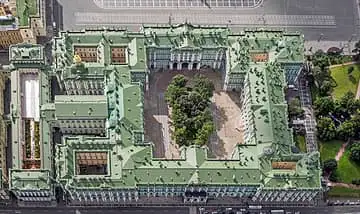
Church of the Savior on Spilled Blood. (81 m vs 23.5 m) Winter Palace (Hermitage) →
Nearby on the globe
.JPG)
Sources
- Read more on Wikipedia
- Church of the Savior on Blood — Wikipedia
- 피의 구원 사원 — 위키백과
- Museum-monument Savior on Spilled Blood — Visit Petersburg
Updated: 2026-10-13