
Winter Palace (Hermitage)
겨울 궁전 (에르미타주)
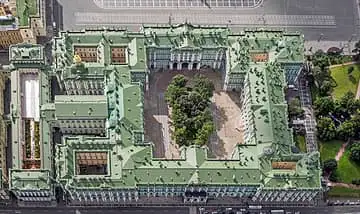
The Winter Palace is a huge green-and-white palace on the bank of the Neva River in Saint Petersburg, Russia. From 1732 to 1917 it was the official home of the Romanov family, the emperors and empresses of Russia, called tsars. The building you see today was designed by the Italian architect Bartolomeo Rastrelli in a richly decorated style called Baroque and built from 1754 to 1762 for Empress Elizabeth.
See it on the 3D globe →At a glance
- Country
- Russia
- Location
- Saint Petersburg, Russia
- Built
- 1762
- Height
- 23.5 m
- Type
- Palace
Quick answers
Where is Winter Palace (Hermitage)?
Winter Palace (Hermitage) is in Saint Petersburg, Russia.
When was Winter Palace (Hermitage) built?
Winter Palace (Hermitage) was built in 1762.
How tall is Winter Palace (Hermitage)?
Winter Palace (Hermitage) is about 23.5 m tall.
The Baroque former residence of the Russian tsars, now part of the Hermitage Museum.
It is one of the largest palaces in Europe, with well over a thousand rooms. Today it is the main building of the State Hermitage Museum, one of the biggest museums in the world. The Hermitage was started in 1764 by Empress Catherine the Great and now holds more than three million objects, from paintings and sculptures to ancient treasures and coins.
History
There were several earlier winter palaces on this riverbank; the present one is the fourth. Catherine the Great, who ruled from 1762, added a quieter wing she called the Hermitage, a word for a hermit's retreat, to hold her growing art collection. On 17 December 1837 a terrible fire burned out almost all of the interiors. Emperor Nicholas I had them rebuilt by 1839, keeping the outside the same. In 1917, during the Russian Revolution, soldiers and sailors entered the palace and arrested the government ministers meeting there, an event later remembered as the storming of the Winter Palace.
What the palace looks like
The main front facing Palace Square stretches about 215 metres. Rows of white columns divide the long walls, and the roof edge is lined with 178 statues and vases. Inside, it has been counted to have about 1,945 windows, 1,886 doors and 117 staircases. The palace has not always been green: its walls were first painted a golden sand colour, later a dark red, and the green-and-white colours we see now date from 1946. Many of the grand halls were redesigned in different styles after the 1837 fire.
The Hermitage Museum today
The museum began when Catherine the Great bought a collection of paintings from a Berlin merchant in 1764, and she went on to buy whole collections containing works by artists such as Rembrandt, Rubens, Titian and Raphael. The museum has been open to the public since 1852, and after the revolution the whole Winter Palace became part of it. Only a small part of its more than three million objects is on display at any time; about a third of them are coins and medals. Entry is free every day for children and students.
Fun facts
- The Hermitage Museum holds about three million items.
- By the end of the 1800s, the tsars ruled from this palace over almost one sixth of all the land on Earth.
- The palace has about 1,945 windows.
- Before it was green and white, the Winter Palace was painted dark red.
- The Hermitage celebrates its birthday every year on 7 December, Saint Catherine's Day.
On the globe
The model shows the long Baroque palace of the Russian tsars in Saint Petersburg, which is now part of the Hermitage Museum. Zoom in to see how far its rows of windows stretch along the riverfront.
Quiz time
Which is taller: Winter Palace (Hermitage) or Church of the Savior on Spilled Blood?
Show the answer
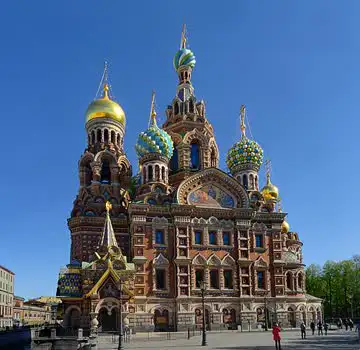
Church of the Savior on Spilled Blood. (23.5 m vs 81 m) Church of the Savior on Spilled Blood →
Nearby on the globe
.jpg)
Sources
- Read more on Wikipedia
- Winter Palace — Wikipedia
- Hermitage Museum — Wikipedia
- 겨울 궁전 — 위키백과
- Winter Palace — Encyclopaedia of Saint Petersburg
Updated: 2026-10-13