
Cité de Carcassonne
카르카손
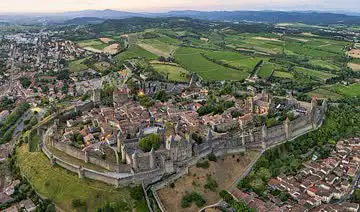
The Cité de Carcassonne is a medieval fortified town on a hill beside the Aude River in southern France. It is best known for its double ring of walls, about 3 kilometres long and dotted with 52 towers. Together with its pointed slate roofs, the walls make it look like a place from a fairy tale.
See it on the 3D globe →At a glance
- Country
- France
- Location
- Carcassonne, France
- Built
- Walls 3rd–13th c.; restored 1853–1911
- Type
- Fort
Quick answers
Where is Cité de Carcassonne?
Cité de Carcassonne is in Carcassonne, France.
A medieval fortified city ringed by double walls and 52 towers with pointed slate roofs.
The hill has a history of about 2,500 years. It began as a Gaulish settlement, and the Romans fortified it in the 3rd century CE. Visigoths and Crusaders also held it. In the 19th century the architect Eugène Viollet-le-Duc led a big restoration. UNESCO added the Cité to the World Heritage list in 1997 as an exceptional example of a medieval fortress town's architecture and planning.
How did the Romans defend it?
The Roman defenses were in place by 333 CE, when the town was described as a castellum, a small fort. The original walls were supported by between 34 and 40 towers, spaced 18 to 30 metres apart. Each tower was semicircular and about 14 metres tall. There were probably about 40 main entrances. The Visigoths rebuilt the Gallo-Roman walls in the 5th and 6th centuries but kept the original structure.
What happened in the Middle Ages and after?
In the Middle Ages, Bernard Aton IV Trencavel, the viscount of Albi, Nimes, and Beziers, started a period of prosperity with many building projects. At the end of the 19th century the theorist and architect Eugène Viollet-le-Duc restored the citadel. Thanks to that work, and to later care, visitors can still walk along the walls and imagine the Middle Ages.
Fun facts
- The double walls are about 3 km long and have 52 towers.
- The hill has about 2,500 years of history.
- A 19th-century architect, Viollet-le-Duc, restored the fortress.
On the globe
The model shows a medieval walled city ringed by two walls and 52 towers with pointed slate roofs.
Nearby on the globe



Sources
Updated: 2026-10-14