
Lascaux
라스코 동굴
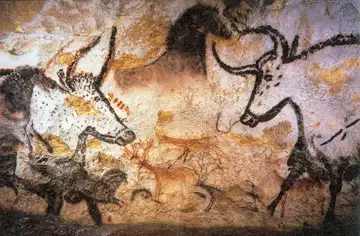
On a hill above Montignac in France's Dordogne, this cave holds more than 600 paintings of bulls, horses, deer and other animals, made by Ice Age people about 17,000 years ago. Teenager Marcel Ravidat found it in 1940 after his dog sniffed out a hole under a fallen tree, and in the Hall of the Bulls one bull is more than 5 m long. The breath and moisture of crowds of visitors let mould grow on the walls, so the cave has been closed since 1963, and people now see exact copies nearby, such as Lascaux IV.
See it on the 3D globe →At a glance
- Country
- France
- Kind
- Off-limits places
Quick answers
Where is Lascaux?
Lascaux is in France.
Lascaux is a network of caves near the village of Montignac in the Dordogne region of southwestern France. More than 600 wall paintings cover its walls and ceilings, mostly of large animals that lived in the area during the last Ice Age. They were made by many generations of people, and are usually dated to about 17,000 to 22,000 years ago.
UNESCO added Lascaux to the World Heritage List in 1979 as part of the Prehistoric Sites and Decorated Caves of the Vézère Valley. The real cave has been closed to visitors since 1963 because people's breath and body heat were damaging the paintings. Exact copies let everyone see the art today. The globe marks it as a cave of ancient art.
Found by a dog and four teenagers
On 12 September 1940, 18-year-old Marcel Ravidat found the entrance when his dog investigated a hole left by a fallen tree. He returned with three friends and they slid down a 15-metre shaft, hoping to find a secret passage to a nearby manor. Instead they found walls covered with animals.
They named the galleries, such as the Hall of the Bulls, the Nave, the Apse and the Chamber of Felines. The priest and archaeologist Henri Breuil visited nine days later and made many sketches.
What the paintings show
More than 900 images are animals, and 605 have been identified exactly. Of these, 364 are horses and 90 are stags. Aurochs (wild cattle) and bison each make up 4 to 5 percent, and there are also seven big cats, a bird, a bear and a rhinoceros. The only human figure is at the bottom of a 9-metre well.
The Hall of the Bulls has four black aurochs bulls, one 5.2 metres long, the largest animal in cave art found so far. Artists used ochre, hematite, manganese and sometimes charcoal, dabbed on or blown through a tube.
Saving the cave, sharing the art
The cave opened to the public in 1948. By 1955, 1,200 visitors a day had produced carbon dioxide, heat and humidity that damaged the paintings, and fungus and lichen spread. It closed in 1963 and is now monitored every day.
Replicas followed: Lascaux II opened near the cave in 1983, Lascaux III toured the world from 2012, and Lascaux IV, a full-size copy of the whole cave, opened in 2016 400 metres away.
Fun facts
- The cave has been closed to visitors since 1963 to protect its roughly 17,000-year-old paintings, so people visit full-size copies nearby instead.
- The paintings on the Crossed Bison show early use of overlapping to create depth.
- Lascaux II was painted with the same sorts of materials thought to have been used about 19,000 years ago.
- Four large black aurochs bulls dominate the Hall of the Bulls among 36 animals.
- A large puzzling animal with two straight lines on its forehead is nicknamed the 'unicorn'.
On the globe
The toy globe marks Lascaux in the Dordogne, France. Zoom in to look for the cave with its Ice Age paintings.
Quiz time
Which is older: Lascaux or Pont du Gard?
Show the answer
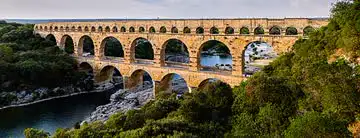
Pont du Gard. (1940 vs 50) Pont du Gard →
Nearby on the globe


Sources
Updated: 2026-10-14