
Fort Jesus
지저스 요새
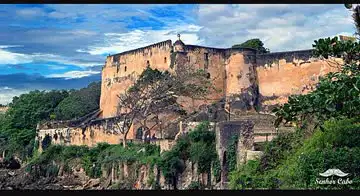
Fort Jesus is a fort on Mombasa Island in Kenya. The Italian architect Giovanni Battista Cairati designed it, and it was built between 1593 and 1596 on the orders of King Felipe II of Spain, who was also King Filipe I of Portugal. Its job was to guard the Old Port of Mombasa. It was the first European-style fort built outside Europe that was designed to resist cannon fire, and it is the only fort kept by the Portuguese on the Swahili coast.
See it on the 3D globe →At a glance
- Country
- Kenya
- Location
- Mombasa, Kenya
- Built
- 1596
- Type
- Fort
Quick answers
Where is Fort Jesus?
Fort Jesus is in Mombasa, Kenya.
When was Fort Jesus built?
Fort Jesus was built in 1596.
A Portuguese coral-stone fort guarding Mombasa's harbour, laid out in the shape of a human figure.
The fort is roughly square with four bulwarks at its corners, and from the air it is said to look like a person lying on their back with the head toward the sea. It is considered a masterpiece of late Renaissance military design. In 2011 UNESCO made it a World Heritage Site, and it is Mombasa's most visited tourist attraction.
A fort that changed hands
Between 1631 and 1875 the fort was won and lost nine times by the powers fighting over this coast. The Portuguese lost it to Sultan Yusuf ibn al-Hasan of Mombasa in 1631, and recaptured it in 1632. From 1696 to 1698 the Omani Arabs, led by Saif bin Sultan, besieged it for almost three years, and when it fell the Portuguese presence on the coast ended. The Omanis took it again in 1837, and in 1895 the British occupied it and used it as a prison.
Portuguese, Omani and British
The walls are about 18 metres high. The Portuguese built them 15 metres tall, and the Omani Arabs added 3 metres. Portuguese cannons were longer than the British ones, with a range of about 200 metres compared with 300 metres for the British. The Omanis left inscriptions from the Quran on wooden door posts and ceiling beams. Local Swahili people supplied the masonry skills, materials and labour.
From prison to museum
In 1958 the fort became a national museum. James Kirkman then excavated it between 1958 and 1971. Visitors can see Oman House, once the home of the sultan who governed the coast, a Portuguese open cistern for rainwater, and a 76-foot-deep well dug by the Arabs, though the water was too salty for anything but washing.
Fun facts
- The fort was won and lost nine times between 1631 and 1875.
- From above, its plan is said to look like a person lying on their back.
- The walls are 18 metres high, with 3 metres added by the Omani Arabs.
- A 76-foot-deep well dug there gave water too salty to drink.
On the globe
The model shows the square coral-stone fort with its corner bastions beside Mombasa's harbor. Look at the thick walls and the shape of the whole enclosure.
Quiz time
Which is older: Fort Jesus or Serengeti National Park?
Show the answer
Fort Jesus. (1596 vs 1951) Serengeti National Park →
Nearby on the globe

Sources
Updated: 2026-10-14