
Mount Kilimanjaro
킬리만자로산
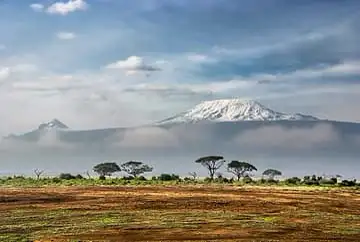
Mount Kilimanjaro is the highest mountain in Africa. It rises to about 5,895 metres in northeastern Tanzania, close to the border with Kenya, and its summit is often capped with ice and snow even though it stands not far south of the equator.
See it on the 3D globe →At a glance
- Country
- Tanzania
- Location
- Northeastern Tanzania
- Height
- 5,895 m
- Type
- Mountain
Quick answers
Where is Mount Kilimanjaro?
Mount Kilimanjaro is in Northeastern Tanzania.
Africa's highest peak and the world's tallest free-standing mountain, capped by glaciers.
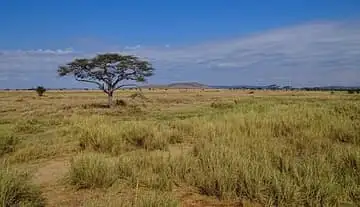
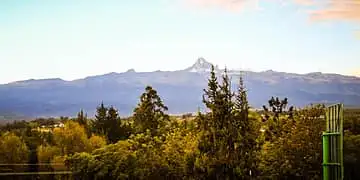
Kilimanjaro is not part of a mountain range. It stands alone on a wide plain, which makes it the tallest free-standing mountain in the world. It is a huge volcano built from three cones: Kibo, the highest, plus Mawenzi and Shira. Kibo is dormant, meaning it is quiet but could in theory erupt again, while the other two are extinct. The mountain is protected as Kilimanjaro National Park, which became a UNESCO World Heritage Site in 1987, and tens of thousands of people try to climb it every year.
From rainforest to ice
Climbing Kilimanjaro is like walking from the tropics to the Arctic in a few days. The lower slopes are farmland and bush. Higher up comes a rainforest where blue monkeys live, then heather and moorland, then a cold, rocky alpine desert. The very top, above about 5,000 metres, is an icy summit zone. Each band has its own plants and weather because the air gets colder and thinner the higher you go.
Shrinking glaciers
Kilimanjaro's white cap is made of glaciers, which are slow rivers of ice. They have been melting away for more than a hundred years. Between 1912 and 2011 the mountain lost about 85 percent of its ice cover, and satellite studies suggest the loss since 1900 is even greater. Scientists expect most of the remaining ice could be gone within a few decades. The glaciers matter because they are a clear sign of how Earth's climate is changing.
Climbing to the roof of Africa
The highest point is Uhuru Peak, on the rim of Kibo's crater. The first people recorded reaching the summit were Hans Meyer and Ludwig Purtscheller in 1889, guided by a young local man, Yohani Kinyala Lauwo. Today climbers do not need ropes or special gear on the main routes, but the climb is still serious: the thin air can cause altitude sickness, so people walk slowly and take several days to get used to the height.
Fun facts
- The glaciers on its summit have shrunk by more than 80% in the last hundred years.
- Uhuru, the name of the highest point, means "freedom" in Swahili.
- The local guide on the first recorded climb in 1889, Yohani Kinyala Lauwo, was only about 18 years old.
- On one climb you pass through five different climate zones, from warm farmland to a frozen summit.
- Kilimanjaro is the tallest mountain on Earth that stands all by itself instead of in a range.
On the globe
The model shows Africa's highest peak rising alone from the plains of Tanzania, with glaciers on its summit. Look for the white ice cap on top of the broad volcano.
Nearby on the globe

Sources
Updated: 2026-10-13