
Fushimi Inari Taisha
후시미 이나리 신사
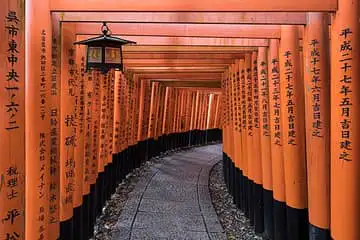
Fushimi Inari-taisha is the head shrine of Inari, the Shinto kami (spirit or god) of rice and farming, in Fushimi-ku, Kyoto, Japan. It sits at the foot of Mount Inari, which is 233 metres high.
See it on the 3D globe →At a glance
- Country
- Japan
- Location
- Kyoto, Japan
- Built
- 711
- Type
- Religious building
Quick answers
Where is Fushimi Inari Taisha?
Fushimi Inari Taisha is in Kyoto, Japan.
When was Fushimi Inari Taisha built?
Fushimi Inari Taisha was built in 711.
The head Inari shrine, where thousands of vermilion torii gates form tunnels up the mountain.
The shrine is famous for its roughly 10,000 bright red-orange torii gates. About 800 of them stand in a row, called the Senbon Torii, and form a tunnel that winds up the mountain. Trails of about 4 kilometres lead to many smaller shrines and take roughly two hours to climb.
History
The shrine is traditionally said to have been founded in 711 by the Hata clan, a powerful group of immigrants from the Korean Peninsula who were skilled in farming. A legend tells that a rich landowner shot an arrow at a rice cake, which turned into a white bird. It flew to the top of Mount Inari, and rice grew where it landed.
Inari began as a god of rice and farming, and later merchants also prayed to Inari for good business. The shrine had the support of the Emperor from the early Heian period.
Gates and foxes
Each torii gate was given by a Japanese business or person, and they mark the entrance to the sacred space of the kami and guard it against evil. Inari has as many as 32,000 smaller shrines across Japan, and this is the main one.
Fox statues stand all around, because foxes are thought to be the messengers of Inari.
Fun facts
- Fox statues stand all over the shrine, because foxes are thought to be messengers of the god Inari.
- There are roughly 10,000 torii gates, and each one was donated.
- About 800 gates in a row form the Senbon Torii tunnel.
- The mountain trails run about 4 kilometres and take roughly 2 hours to climb.
- Fox statues around the shrine represent messengers of Inari.
On the globe
The model shows the main shrine and the vermilion torii gates winding up the hill.
Quiz time
Which is older: Fushimi Inari Taisha or Kiyomizu-dera?
Show the answer
Fushimi Inari Taisha. (711 vs 1633) Kiyomizu-dera →
Nearby on the globe


Sources
Updated: 2026-10-14