
Kinkaku-ji
금각사
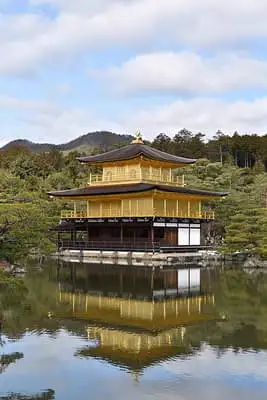
Kinkaku-ji, the "Temple of the Golden Pavilion", is a Zen Buddhist temple in Kyoto, Japan, whose official name is Rokuon-ji, or "Deer Garden Temple". Its most famous building is a three-storey pavilion with the top two floors covered in thin gold leaf, reflected in a calm pond in front of it. The pavilion is about 12.5 metres tall.
See it on the 3D globe →At a glance
- Country
- Japan
- Location
- Kyoto, Japan
- Built
- 1397
- Height
- 12 m
- Type
- Religious building
Quick answers
Where is Kinkaku-ji?
Kinkaku-ji is in Kyoto, Japan.
How tall is Kinkaku-ji?
Kinkaku-ji is about 12 m tall.
A Zen temple whose gold-leaf-covered pavilion is mirrored in the surrounding pond.
The shōgun Ashikaga Yoshimitsu turned the site into his retreat in 1397, and after his death it became a Zen temple. It is a UNESCO World Heritage Site as one of the Historic Monuments of Ancient Kyoto, and one of the most visited places in Japan. The building is a shrine hall that holds relics of the Buddha.
History
The land first held a villa that belonged to a powerful statesman, Saionji Kintsune. In 1397 Yoshimitsu bought it and built the Golden Pavilion, believed to date from 1399. Gold was used for its meaning of purifying negative feelings about death. During the Ōnin War (1467-1477) all of the other buildings were burned, but the pavilion survived.
Burned and rebuilt
On 2 July 1950 a 22-year-old trainee monk set fire to the pavilion and it burned down, including a statue of Yoshimitsu. The pavilion was rebuilt and finished in 1955, and the gold leaf on it is only about 0.5 micrometres thick, thinner than a human hair by far. Today the temple is a national special historic site and a place of special scenic beauty.
Three styles and a mirror pond
Each floor of the Golden Pavilion uses a different style of building: the shinden style of the Heian nobles, the samurai style and the Zen style. The roof is a pyramid with a bronze phoenix on top. The pavilion stands over a pond called Kyoko-chi, the Mirror Pond, which has ten small islands. Rocks, bridges and plants are placed to recall famous places in Chinese and Japanese stories. After the pavilion's gold leaf peeled in 1984, it was re-covered in 1986 and 1987 with 20 kilograms of 0.5-micrometre gold leaf, and the roof was restored in 2003.
Fun facts
- The gold leaf covering the top two floors is about 0.5 micrometres thick.
- The official name is Rokuon-ji, the "Deer Garden Temple".
- The pavilion was burned in 1950 and rebuilt in 1955.
- Only the pavilion survived the Ōnin War, when the other buildings burned.
On the globe
The model shows the golden pavilion reflected in its pond.
Quiz time
Which is taller: Kinkaku-ji or Kiyomizu-dera?
Show the answer
Kiyomizu-dera. (12 m vs 31 m) Kiyomizu-dera →
Nearby on the globe

Sources
Updated: 2026-10-14