
Gyeongbokgung Palace
경복궁
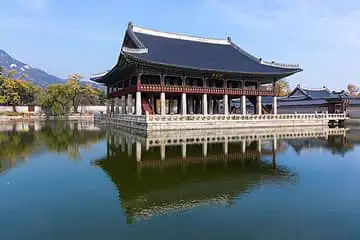
Gyeongbokgung is a royal palace in Seoul, South Korea, and the first palace of the Joseon dynasty. It was built in 1395, three years after King Taejo founded the Joseon dynasty, and it served as the dynasty's main palace. The palace sits at the foot of Bugaksan mountain, so its tiled roofs appear framed by green peaks. Its name was chosen by the scholar Jeong Do-jeon from an old book of poems, and it expresses the wish that the new kingdom would be greatly blessed.
See it on the 3D globe →At a glance
- Country
- South Korea
- Location
- Seoul, South Korea
- Built
- 1395
- Type
- Palace
Quick answers
Where is Gyeongbokgung Palace?
Gyeongbokgung Palace is in Seoul, South Korea.
When was Gyeongbokgung Palace built?
Gyeongbokgung Palace was built in 1395.
The main royal palace of the Joseon dynasty, set against the mountains north of Seoul.
The palace has been destroyed and rebuilt more than once, so its story is also the story of Korea. Today it is one of the most visited places in the country. Inside are grand halls, peaceful ponds, and two museums: the National Palace Museum of Korea and the National Folk Museum of Korea.
History
King Sejong, who created the Korean alphabet Hangul, ruled from Gyeongbokgung. In 1592, during the Japanese invasion known as the Imjin War, the palace burned down and lay in ruins for about 270 years. In 1865 the regent Heungseon Daewongun began a huge rebuilding project; the main halls were finished in 1867 and the royal family moved back in 1868. During the Japanese colonial period (1910-1945) most of the buildings were torn down, and a large colonial government building was put up in front of the throne hall. That building was demolished in 1995-1996, and restoration work has continued since 1990, with plans running to 2045.
What's inside
Visitors enter through Gwanghwamun, the main gate. At the heart of the palace is Geunjeongjeon, the throne hall where kings were crowned and met foreign envoys; it is National Treasure No. 223. Gyeonghoeru is a large pavilion that seems to float on an artificial pond. Kings held banquets there for foreign guests, and the present building dates from 1867. Further north, the small hexagonal pavilion Hyangwonjeong stands on a small island in the middle of a pond.
Visiting today
One favourite sight is the Royal Guard Changing Ceremony, a reenactment of how guards swapped duty at the palace gates in Joseon times, with drums, flags and colourful uniforms. It is usually held twice a day, but it can be cancelled in bad weather, so it is worth checking the schedule. The palace grounds are wide: the outer wall runs about 2.4 km around them and has four gates, one facing each direction.
Fun facts
- King Sejong, who created Hangul, ruled from Gyeongbokgung.
- After burning in 1592, the palace stayed in ruins for about 270 years.
- Gyeonghoeru was where Joseon kings held banquets for foreign guests, beside a man-made pond.
- The palace walls stretch about 2.4 km around the grounds.
- A colonial government building that blocked the palace was torn down in 1995-1996.
On the globe
The model shows the main royal palace of the Joseon dynasty set against the mountains north of Seoul. Look for its tiled palace roofs with the peaks behind them.
Quiz time
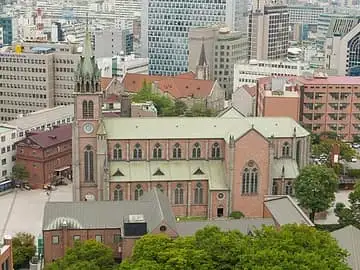
Which is older: Gyeongbokgung Palace or Myeongdong Cathedral?
Show the answer
Gyeongbokgung Palace. (1395 vs 1898) Myeongdong Cathedral →
Nearby on the globe
_at_Gyeongbokgung_Palace,_Seoul.jpg)
Sources
- Read more on Wikipedia
- Gyeongbokgung — Wikipedia
- 경복궁 — 위키백과
- Gyeongbokgung Palace: Main palace of Joseon Kingdom — The Korea Times (text from the Cultural Heritage Administration)
Updated: 2026-10-13