
Hwaseong Fortress
수원 화성
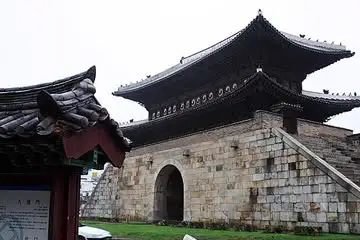
King Jeongjo's 5.7 km fortress wall blending Eastern and Western military engineering, entered through the great Janganmun and Paldalmun gates.
See it on the 3D globe →At a glance
- Country
- South Korea
- Location
- Suwon, South Korea
- Built
- 1796
- Type
- Fort
Quick answers
Where is Hwaseong Fortress?
Hwaseong Fortress is in Suwon, South Korea.
When was Hwaseong Fortress built?
Hwaseong Fortress was built in 1796.
Hwaseong Fortress, or Suwon Hwaseong, is a Korean fortress that surrounds the centre of Suwon, about 30 kilometres south of Seoul. King Jeongjo of the Joseon dynasty built it from 1794 to 1796. He wanted a place to honour the remains of his father, Crown Prince Sado.
The wall is about 5.74 kilometres long and has four main gates, watchtowers, a beacon tower and two floodgates over the Suwoncheon stream. UNESCO made it a World Heritage Site in 1997. It was damaged in the Korean War, but a detailed record of its building survived, so it could be rebuilt.
Why it was built
King Jeongjo seems to have planned to move the capital from Seoul to Suwon, which sat on the road toward the Yellow Sea and China. To help the town grow he moved people there and freed them from taxes for ten years. The fortress also answered a lesson of the Imjin war: instead of a simple town wall plus a separate mountain fortress, Hwaseong joined wall, fort and town centre in one.
How it was built
The architect Jeong Yak-yong, a thinker of the Silhak or 'practical learning' movement, mixed Korean and Chinese fortress ideas with the science of his day. Brick, pulleys and cranes made the work faster. The job took about two and a half years. Unlike older government projects, the workers were paid, with wages recorded in the account books.
The book that saved it
In 1801 a ten-volume report called the Hwaseong Seongyeok Uigwe was published. It lists plans, supervisors, royal orders, wages, and the quantities of each material used. When the fortress was badly damaged in the Korean War, this book guided its rebuilding from the 1970s. That is one reason UNESCO accepted a restored building as a World Heritage Site.
Fun facts
- It took less than three years to build, helped by a crane designed by the scholar Jeong Yak-yong.
- The beacon tower has five chimneys: one lit means peace, and five lit means fighting has begun.
- Janganmun, the north gate, is described as the largest gate in Korea.
- The fortress took about 2.5 years to build, and workers were paid wages instead of being drafted.
- Today the busy south gate, Paldalmun, stands alone like an island among traffic.
On the globe
The model shows the long stone wall with its gates and towers. Look for the big gates Janganmun and Paldalmun.
Quiz time
Which is older: Hwaseong Fortress or Gyeongbokgung Palace?
Show the answer
Gyeongbokgung Palace. (1796 vs 1395) Gyeongbokgung Palace →
Nearby on the globe

Sources
- Read more on Wikipedia
- Hwaseong Fortress — Wikipedia
- 수원 화성 — 위키백과
- Hwaseong Fortress — Wikipedia (full article)
Updated: 2026-10-14