
Kīlauea
킬라우에아 화산
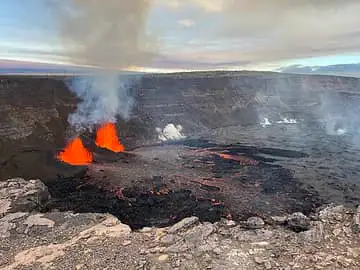
Kīlauea is one of the most active volcanoes on Earth. It is a shield volcano on the southeastern shore of Hawaii Island, in the U.S. state of Hawaii, and it rises about 1,200 meters above sea level. A shield volcano has broad, gently sloping sides made by runny lava.
See it on the 3D globe →At a glance
- Country
- United States
- Location
- Hawaiʻi, USA
- Height
- 1,247 m
- Type
- Volcano
Quick answers
Where is Kīlauea?
Kīlauea is in Hawaiʻi, USA, United States.
One of the world's most active volcanoes, held in Hawaiian tradition to be home of the fire goddess Pele.
In Hawaiian tradition the crater called Halemaʻumaʻu is the home of Pele, goddess of fire and volcanoes. Kīlauea erupted almost nonstop from 1983 to 2018, and a new eruption began in December 2024 inside Halemaʻumaʻu, with lava fountains that come and go. The name is a Hawaiian word meaning spewing or much spreading, which suits a mountain that so often pours out lava.
How old is it?
The volcano is between 210,000 and 280,000 years old and grew above the sea about 100,000 years ago. It is the second-youngest volcano made by the Hawaiian hotspot, a hot spot deep in Earth that has built the island chain. It has a big summit caldera and two active rift zones, long cracks where lava escapes, one 125 kilometres to the east and one 35 kilometres to the west. Lava younger than 1,000 years covers about 90 percent of its surface.
Eruptions and people
Hawaiian oral history remembers a major eruption around 1410. In 1790 an explosive eruption killed more than 400 people. The long eruption from 1983 to 2018 covered about 123 square kilometres with new land and destroyed the towns of Kalapana and Kaimū in 1990.
In 2018 lava poured from vents in the lower Puna area, reached the ocean and destroyed 716 homes, while the summit lava lake drained and Hawaii Volcanoes National Park closed for months.
Pele and the volcano watchers
Native Hawaiians have long held the island's volcanoes sacred, and Halemaʻumaʻu is seen as the body and home of Pele. The English missionary William Ellis gave the first modern account of the volcano, after spending two weeks exploring it. Scientists have studied it ever since: the Hawaiian Volcano Observatory was founded by Thomas Jaggar in 1912, and Hawaii Volcanoes National Park was created in 1916. Wildlife lives all around the mountain, and much of it is found nowhere else.
Fun facts
- Kīlauea erupted nearly continuously for 35 years, from 1983 to 2018.
- Its summit caldera is called Kaluapele, the pit of Pele.
- Hawaii Volcanoes National Park was created in 1916.
- In 2018, lava destroyed 716 homes.
On the globe
The model shows the volcano with its glowing crater and lava flows.
Nearby on the globe



Sources
Updated: 2026-10-14