
Diamond Head
다이아몬드 헤드
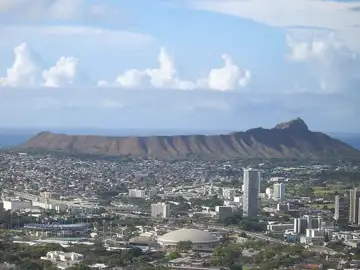
Diamond Head is a volcanic crater on the island of Oʻahu in Hawaii, USA. It rises at the eastern end of Waikīkī Beach in Honolulu, and its sharp ridge, whose highest point is about 232 metres above the sea, appears in countless photos, films and TV shows. It is Hawaii's most recognised landmark.
See it on the 3D globe →At a glance
- Country
- United States
- Location
- Honolulu, USA
- Height
- 232 m
- Type
- Volcano
Quick answers
Where is Diamond Head?
Diamond Head is in Honolulu, USA, United States.
How tall is Diamond Head?
Diamond Head is about 232 m tall.
The volcanic tuff-cone crater rising behind Waikiki Beach, Hawaii's most recognisable skyline.
Hawaiians call it Lēʻahi. The name most likely joins words meaning "brow" and "tuna", because the ridge looks like the back fin of a tuna fish. Diamond Head is a tuff cone: a hill made of volcanic ash that settled and hardened into rock called tuff. Today it is protected as Diamond Head State Monument, and since 1968 it has also been a U.S. National Natural Landmark. More than 3,000 people a day hike to its summit.
How it formed
Diamond Head was made by a single, explosive eruption that threw ash and tiny bits of rock into the air. As they fell back down, they cemented together into tuff and built a wide, saucer-shaped crater. Hawaii's state parks say this happened about 300,000 years ago, while other scientific estimates put it at 400,000 to 500,000 years ago. Either way, it is much younger than the Koʻolau mountains behind it, which are about 2.6 million years old.
Why is it called Diamond Head?
In 1825 British sailors spotted sparkling crystals in the rocks and sand near the crater and thought they had found diamonds, so they named it Diamond Hill. The crystals were really calcite, a common, shiny mineral. Later the name changed to Diamond Head, "head" being short for headland, a point of land sticking out into the sea. Locals also call it Kaimana Hila, a Hawaiian way of saying "Diamond Hill".
Hiking to the top
The summit trail was built in 1908 as part of Oʻahu's coastal defence system. It is about 1.3 kilometres long and climbs roughly 170 metres from the crater floor, with switchbacks, steep stairs and a lit tunnel about 70 metres long. At the top is a Fire Control Station, finished in 1911, that once directed army guns. From there you can see the coast from Koko Head to Waiʻanae, and in winter you may spot humpback whales. A lighthouse built in 1917 stands on the outer slope.
Fun facts
- British sailors named it after mistaking sparkling calcite crystals on its slopes for diamonds.
- The "diamonds" that gave Diamond Head its name were really shiny calcite crystals.
- The inside of the crater was once Fort Ruger, the first U.S. military base in Hawaii.
- Most of the plants and birds you see in the crater today were brought to Hawaii in the late 1800s and early 1900s.
- In 1964 a guitar song called "Diamond Head" by The Ventures became a huge hit, especially in Japan.
On the globe
The model shows the broad volcanic crater with its sharp ridge rising above the Honolulu shoreline. Zoom in to see the bowl-shaped crater floor inside the ring of cliffs.
Quiz time
Which is taller: Diamond Head or Aloha Tower?
Show the answer
Diamond Head. (232 m vs 56 m) Aloha Tower →
Nearby on the globe





Sources
- Read more on Wikipedia
- Diamond Head, Hawaii — Wikipedia
- 다이아몬드헤드산 — 위키백과
- Diamond Head State Monument — Hawaii Division of State Parks
Updated: 2026-10-13