
Matterhorn
마터호른
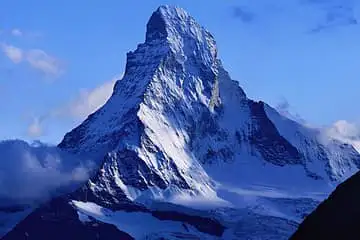
The Matterhorn is a 4,478-metre mountain in the Alps, standing right on the border between Switzerland and Italy. On the Swiss side it towers over the village of Zermatt, and on the Italian side over Breuil-Cervinia. Italians call it Monte Cervino and French speakers call it Mont Cervin.
See it on the 3D globe →At a glance
- Country
- Switzerland
- Location
- Switzerland–Italy border
- Height
- 4,478 m
- Type
- Mountain
Quick answers
Where is Matterhorn?
Matterhorn is in Switzerland–Italy border.
An iconic, near-pyramidal Alpine peak straddling the Swiss–Italian border.
Its shape makes it one of the most recognisable mountains in the world: four steep faces meet in sharp ridges and rise to a pointed tip, almost like a pyramid. Each face points roughly toward one of the four compass directions. Zermatt's tourism office calls it the most photographed mountain on Earth, and it has become a symbol of Switzerland and of the Alps as a whole. Its first climb in 1865 is one of the most famous stories in mountaineering.
The first climb
For years the Matterhorn was thought to be too steep to climb. On 14 July 1865, a team of seven led by the English climber Edward Whymper finally reached the summit from Zermatt, going up the Hörnli ridge. Whymper had already failed many times, mostly from the Italian side, and an Italian team led by Jean-Antoine Carrel was racing up the other side. On the way down, one climber slipped and pulled three others with him, and all four died when the rope snapped. Carrel reached the top from Italy three days later.
Climbing it today
The Hörnli ridge is still the most popular route. Climbers usually spend a night at the Hörnli hut and set off before dawn, and fixed ropes on the upper part help them hold on. According to Zermatt's tourism office, a few hundred people climb with a mountain guide each year, while thousands try on their own and many turn back. The mountain is dangerous: hundreds of climbers have died on it since 1865, and melting permafrost (ground that used to stay frozen) now causes more falling rocks.
Where the name comes from
The German name comes from Matte, meaning meadow, and Horn, meaning peak, so it is often translated as "the peak of the meadows". The name Matterhorn first appears in writing in 1682. The French and Italian names, Cervin and Cervino, are much older and probably come from a Latin name meaning "forest mountain". People in Zermatt simply call it "ds Hore", which means "the peak" in the local dialect.
Fun facts
- Edward Whymper's team made the first ascent in 1865.
- Each of the Matterhorn's four faces points roughly north, south, east or west.
- Before 1865, Edward Whymper tried and failed at least seven times, reaching no higher than about 4,100 metres.
- Its steep west face was not fully climbed until 1962, almost 100 years after the first ascent.
- Monte Rosa, a mountain just across the valley, is almost 170 metres taller, but far less famous.
On the globe
The model shows the Matterhorn's sharp, nearly pyramid-shaped peak on the Swiss–Italian border. Zoom in and turn the globe to see how its faces meet in steep ridges at the pointed summit.
Nearby on the globe

Sources
Updated: 2026-10-13