
Nikkō Tōshō-gū
닛코 도쇼구
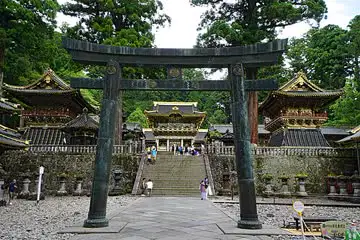
Nikkō Tōshō-gū is a Shinto shrine in Nikkō, Tochigi Prefecture, Japan, built to honour Tokugawa Ieyasu, who founded the Tokugawa shogunate that ruled Japan for more than 250 years. Ieyasu is enshrined here and his remains are buried on the hill above. The first shrine was built in 1617.
See it on the 3D globe →At a glance
- Country
- Japan
- Location
- Nikkō, Japan
- Built
- 1636
- Height
- 36 m
- Type
- Religious building
Quick answers
Where is Nikkō Tōshō-gū?
Nikkō Tōshō-gū is in Nikkō, Japan.
When was Nikkō Tōshō-gū built?
Nikkō Tōshō-gū was built in 1636.
How tall is Nikkō Tōshō-gū?
Nikkō Tōshō-gū is about 36 m tall.
Shrine of Tokugawa Ieyasu, famed for the lavishly carved and gilded Yōmeimon gate and its five-storey pagoda.
It is famous for its richly carved and painted buildings, especially the Yōmeimon gate and a five-storey pagoda. With Futarasan Shrine and Rinnō-ji temple, it forms the UNESCO World Heritage Site called the Shrines and Temples of Nikkō, which includes 42 shrine structures.
Who was Ieyasu, and how did the shrine grow?
The shrine was first built in 1617 while Ieyasu's son Hidetada was shogun. It was enlarged under the third shogun, Iemitsu. In the Edo period grand processions travelled from Edo (now Tokyo) to Nikkō along the Nikkō Kaidō road, lined with cedar trees. The spring and autumn festivals still reenact them as the 'procession of a thousand warriors'.
What can you see?
The Yōmeimon gate is covered in deep carvings in rich colours; its nickname means you could look at it until sunset without getting tired. The sacred stable has the famous carving of the three monkeys who see, hear and speak no evil, and nearby is the carving of a sleeping cat, attributed to Hidari Jingorō. The current five-storey pagoda was rebuilt in 1818 after a fire, and each floor stands for an element: earth, water, fire, wind and void. Inside, a central pillar hangs from chains to reduce earthquake damage.
Fun facts
- Its stable is carved with the famous 'see no evil, hear no evil, speak no evil' monkeys.
- The Yōmeimon gate is nicknamed the gate you can look at until the sun goes down.
- The pagoda's central pillar hangs from chains to protect it from earthquakes.
- In 2008 Yuri Kawasaki became the first woman to serve as a Shinto priest at the shrine.
On the globe
The toy model shows the gilded Yōmeimon gate and the five-storey pagoda of the shrine.
Quiz time
Which is taller: Nikkō Tōshō-gū or Ushiku Daibutsu?
Show the answer
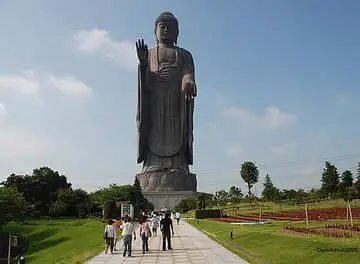
Ushiku Daibutsu. (36 m vs 120 m) Ushiku Daibutsu →
Nearby on the globe


Sources
Updated: 2026-10-14