
Palace of Versailles
베르사유 궁전
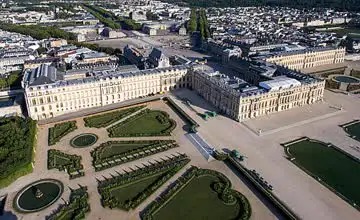
The Palace of Versailles is a gigantic royal palace in the town of Versailles, about 16 kilometres southwest of Paris, France. It began as a small hunting lodge, but King Louis XIV, called the Sun King, turned it into the grandest palace in Europe to show off the power of the French monarchy. From 1682 until 1789, the king, his court and the whole royal government lived and worked there.
See it on the 3D globe →At a glance
- Country
- France
- Location
- Versailles, France
- Built
- 1710
- Type
- Palace
Quick answers
Where is Palace of Versailles?
Palace of Versailles is in Versailles, France.
When was Palace of Versailles built?
Palace of Versailles was built in 1710.
Louis XIV’s showpiece of absolute monarchy, famed for its gilded Royal Gate and Hall of Mirrors.
The palace has roughly 2,300 rooms and sits inside a park of about 815 hectares, with formal gardens, fountains, a long Grand Canal and smaller palaces called the Trianons. Its most famous room is the glittering Hall of Mirrors. Today Versailles is a museum owned by the French state and one of the most visited places in Europe, and its style was copied by palaces all across the continent.
History
In 1623 King Louis XIII built a modest brick-and-stone hunting lodge on the site, which some courtiers mocked as a "house of cards". His son Louis XIV took an interest in 1661 and hired the architect Louis Le Vau, the gardener André Le Nôtre and the painter Charles Le Brun to transform it. In 1682 he moved his court there for good. The royal family stayed until October 1789, when a crowd of Parisians angry about the price of bread marched to Versailles during the French Revolution and forced the king and queen to go to Paris. Later, in the 1830s, the palace became a museum of French history.
The Hall of Mirrors
The Hall of Mirrors is a gallery 73 metres long, designed by the architect Jules Hardouin-Mansart and built from 1678 to 1684. Seventeen tall windows look out over the gardens, and facing them are seventeen arches covered with 357 mirrors, which bounce the daylight around the room. Charles Le Brun painted the curved ceiling with 30 scenes from Louis XIV's reign. The hall was used for royal weddings, balls and the welcoming of foreign ambassadors. In 1919 the Treaty of Versailles, which formally ended the First World War, was signed here.
The gates and gardens
Visitors arrive through a courtyard closed by the gilded Royal Gate. The original gate, designed around 1680, was destroyed in 1794 during the Revolution, and a new version was put up in 2008. Behind the palace, Le Nôtre's gardens stretch out in straight paths, clipped hedges and pools. Before the Revolution the royal estate was about ten times bigger than the park today. A powerful storm in December 1999 knocked down more than 10,000 of its trees, and the gardens were replanted afterwards.
Fun facts
- Louis XIV's own bedroom was placed in the middle of the palace, in the room that had been the central salon of his father's old hunting lodge.
- The Hall of Mirrors has 357 mirrors set into 17 arches, with each mirrored arch facing one of the 17 garden windows.
- The German Empire was proclaimed in the Hall of Mirrors in 1871, and the treaty ending the First World War was signed in the same room in 1919.
- After the royal family left, the palace's furniture was sold at auction in 1793 and 1794, and the museum has spent decades buying pieces back.
On the globe
The model shows Louis XIV's showpiece palace near Paris, with its gilded Royal Gate in front. Zoom in to find the golden gate and imagine the long Hall of Mirrors inside.
Quiz time
Which is older: Palace of Versailles or Colosseum?
Show the answer
Colosseum. (1710 vs 80) Colosseum →
Nearby on the globe
.jpg)
Sources
- Read more on Wikipedia
- Palace of Versailles — Wikipedia
- The Royal Gate of the Palace of Versailles — Wikipedia
- The Hall of Mirrors — Château de Versailles
- 베르사유궁 — 위키백과
Updated: 2026-10-13