
Colosseum
콜로세움
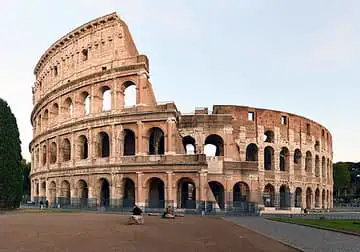
The Colosseum is a huge oval amphitheatre, an open-air arena with rows of seats all the way around, in the centre of Rome, Italy, just east of the Roman Forum. Emperor Vespasian began building it around AD 72, and his son Titus finished it in AD 80. Its official name was the Flavian Amphitheatre, after their family, the Flavians.
See it on the 3D globe →At a glance
- Country
- Italy
- Location
- Rome, Italy
- Built
- 80
- Height
- 48 m
- Type
- Ancient site
Quick answers
Where is Colosseum?
Colosseum is in Rome, Italy.
When was Colosseum built?
Colosseum was built in 80.
How tall is Colosseum?
Colosseum is about 48 m tall.
Ancient Rome's great amphitheatre, where gladiator contests and public spectacles drew tens of thousands.
It is the largest amphitheatre ever built in the ancient world and the largest one still standing anywhere. It could hold an estimated 50,000 to 80,000 spectators, who came to watch gladiator fights, animal hunts and other public shows. Earthquakes and people taking its stones have left it partly ruined, but it remains a famous symbol of ancient Rome and one of the New 7 Wonders of the World.
How it was built
The builders used travertine, a pale limestone, for the outer walls, along with Roman concrete, brick and tuff, a light rock made from volcanic ash. The design was very clever at moving crowds: 80 numbered entrances ringed the ground floor, and spectators had tickets showing which entrance, staircase and seat to use, a lot like a modern stadium. On sunny days, sailors from the Roman navy worked a huge sun shade called the velarium, stretched over the seats on wooden poles.
What's under the arena
The arena floor was made of wood covered with sand. In Latin, sand is "harena", which is where our word "arena" comes from. Under the floor, Emperor Domitian added the hypogeum, a maze of tunnels and rooms. Lifts and pulleys raised scenery, props and caged animals up to the arena floor, where the animals were released in front of the crowd. The wooden floor is mostly gone today, so visitors can look straight down into these tunnels.
After the games ended
Gladiator games were officially abolished in 438, and the Colosseum slowly fell out of use. Over the following centuries it was used for houses, workshops, a fortress and even as a quarry. A great earthquake in 1349 brought down part of the outer south wall, and its fallen stones were reused in palaces, churches and other buildings, including St Peter's Basilica. Today it is run as part of an archaeological park, and visitors can tour the seating levels, the arena and the underground.
Fun facts
- It could hold an estimated 50,000 to 80,000 spectators.
- The name "Colosseum" probably comes from a giant bronze statue of Emperor Nero, called the Colossus, that stood next to it.
- Every one of the 80 ground-floor entrances was numbered, just like the gates of a modern stadium.
- Ancient writers said the arena could be flooded for pretend sea battles in its early years.
- The Colosseum appears on the Italian 5-euro-cent coin.
On the globe
The model shows Rome's great oval arena, ringed by tall outer walls of stacked arches. Zoom in to look down into the arena where the shows once took place.
Quiz time
Which is taller: Colosseum or St. Peter's Basilica?
Show the answer
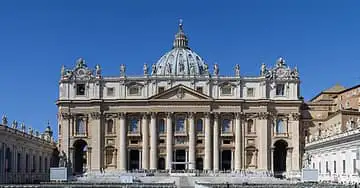
St. Peter's Basilica. (48 m vs 137 m) St. Peter's Basilica →
Nearby on the globe

Sources
- Read more on Wikipedia
- Colosseum — Wikipedia
- The Colosseum — Parco archeologico del Colosseo (official site)
Updated: 2026-10-13