
Pamukkale
파묵칼레
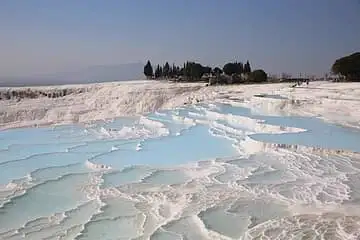
Pamukkale is a natural wonder in Denizli Province in south-western Turkey, where hot spring water has built bright white terraces and pools on a hillside. The name means "cotton castle" in Turkish, because the shining white rock looks like piles of cotton. The terraces stretch about 2,700 metres along the slope, are about 600 metres wide and about 160 metres high.
See it on the 3D globe →At a glance
- Country
- Türkiye
- Location
- Denizli, Türkiye
Quick answers
Where is Pamukkale?
Pamukkale is in Denizli, Türkiye.
Brilliant white travertine terraces of mineral-rich hot springs; the name means "cotton castle".
On top of this white hill stand the ruins of Hierapolis, an ancient Greek and Roman spa city. Both places together were added to the UNESCO World Heritage List in 1988. The glowing terraces can be seen from the hills near the town of Denizli, about 20 kilometres away. It is one of the most visited natural sites in Turkey, with more than two million visitors a year.
How the white terraces form
The rock is travertine, a kind of limestone deposited by mineral-rich water. There are 17 hot springs in the area, with temperatures between 35 and 100 degrees Celsius.
As the spring water flows down the slope, it loses carbon dioxide gas, and the calcium carbonate it carries is left behind, first as a soft gel and slowly as hard white rock. Over thousands of years this builds pool after pool like a staircase.
The ancient spa city
Hierapolis was founded as a hot-spring spa early in the 2nd century BC. It became a healing centre where doctors used the thermal water to treat patients. In AD 17 a major earthquake destroyed the city, and it was rebuilt under Rome.
The Apostle Philip is said to have spent his last years here. In the Byzantine period the Roman baths were turned into a Christian basilica. A museum in the old bath buildings now holds finds from Hierapolis and nearby towns.
Visiting and protecting it
Visitors can bathe in designated thermal pools, including Cleopatra's Pool, where ancient marble columns lie under the water.
To protect the delicate terraces, authorities regulate the water flow and sometimes close certain sections so the formations can recover. Similar travertine terraces exist at Mammoth Hot Springs in the United States and at Badab-e Surt in Iran.
Fun facts
- The ancient Greek spa city of Hierapolis was built at its top.
- Pamukkale means "cotton castle" in Turkish.
- The terraces can be seen from about 20 kilometres away.
- There are 17 hot springs at the site, from 35 to 100 degrees Celsius.
- Ancient marble columns lie under the water of Cleopatra's Pool.
On the globe
The model shows the white terraced pools on the hillside.
Nearby on the globe


Sources
Updated: 2026-10-14