
Persepolis
페르세폴리스
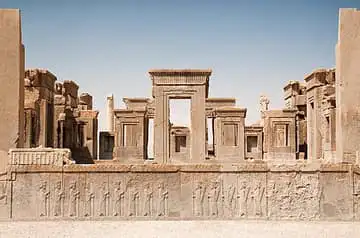
Persepolis was the ceremonial capital of the Achaemenid Persian Empire, which lasted from about 550 to 330 BC. Its ruins stand on a raised stone platform in the plains of Marvdasht, in Fars province, Iran, ringed by the Zagros Mountains. The earliest remains date to about 515 BC. In modern Persian it is called Takht-e Jamshid, "Throne of Jamshid".
See it on the 3D globe →At a glance
- Country
- Iran
- Location
- Fars, Iran
- Built
- c. 518 BC
- Type
- Ancient site
Quick answers
Where is Persepolis?
Persepolis is in Fars, Iran.
Ceremonial capital of the Achaemenid Persian Empire, with grand stairways, columns and fine reliefs.
The complex had grand stairways, five palaces or halls with tall columns, and carved reliefs of people bringing gifts to the king. Its name comes from Greek and means "the Persian city"; to the ancient Persians it was Pārsa. UNESCO has listed it as a World Heritage Site since 1979.
Building Persepolis
Darius I created Persepolis as the splendid seat of government and the centre for receptions and festivals. He ordered the Apadana, the Council Hall and the main Treasury, which his son Xerxes I finished. Later kings kept adding buildings until the empire fell.
Grey limestone was the main building material. The workers were paid with silver and food, and clay tablets list craftsmen from many lands, such as Cappadocia and Lydia.
A place for ceremonies
Persepolis was not one of the biggest cities in the empire. Instead it seems to have been a grand site used for ceremonies, and it was probably occupied only part of the year. Many scholars think it was mainly used for celebrating Nowruz, the Persian New Year at the spring equinox, which is still celebrated in Iran.
The reliefs on the stairways show nobles and people from across the empire bringing gifts.
Fire and rediscovery
In 330 BC the army of Alexander the Great captured Persepolis, and soon after its palaces burned. One account says Alexander set the fire on purpose to take revenge for the Persians' destruction of Athens; another blames a feast and a courtesan.
When explorers studied the site from the early 1600s, the inscriptions in three languages, Old Persian, Elamite and Babylonian, helped scholars finally read cuneiform writing in the early 19th century.
Fun facts
- Alexander the Great burned it in 330 BC.
- Its Persian name Takht-e Jamshid means "Throne of Jamshid", though there is no evidence Jamshid had any link with it.
- Five palaces or halls stood on its walled platform.
- The three-language royal inscriptions found here helped decode ancient cuneiform.
- In 311 AD a Sasanian prince called the site Sad-stūn, "Hundred Pillars".
On the globe
The model shows the stone platform with tall columns and a grand stairway. Look for the rows of columns.
Nearby on the globe
.jpg)
Sources
Updated: 2026-10-14