
Chogha Zanbil
초가 잔빌
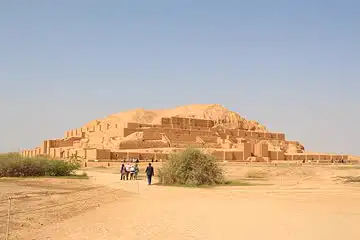
Chogha Zanbil is an ancient Elamite complex in Khuzestan province, Iran, about 30 kilometres southeast of Susa. Its great stepped tower, called a ziggurat, is one of the few ziggurats outside Mesopotamia and is thought by UNESCO to be the best preserved example of this kind of stepped pyramid. The king Untash-Napirisha built it around 1250 BC, mainly to honour the great god Inshushinak.
See it on the 3D globe →At a glance
- Country
- Iran
- Location
- Khuzestan, Iran
- Built
- -1250
- Height
- 25 m
- Type
- Ancient site
Quick answers
Where is Chogha Zanbil?
Chogha Zanbil is in Khuzestan, Iran.
When was Chogha Zanbil built?
Chogha Zanbil was built in 1250 BC.
How tall is Chogha Zanbil?
Chogha Zanbil is about 25 m tall.
An Elamite ziggurat, among the best-preserved stepped temple towers outside Mesopotamia.
The name Chogha Zanbil is usually translated as "basket mound". Its original name was Dur Untash, "town of Untash", but probably few people other than priests and servants ever lived there. In 1979 it became the first Iranian site to be inscribed on the UNESCO World Heritage List. Today the ziggurat stands about 24.75 metres high, less than half its estimated original height.
A holy city with walls
Three concentric walls protected the complex. Inscriptions say the outer wall had seven gates, of which only two have been found. Between the outer and middle walls stood a shared temple to the main Elamite gods Napirisha and Inshushinak, and the middle area held eleven temples to other gods. Inside the inner wall, an area of about 2.5 hectares, nearly everything was taken up by the ziggurat. The outer area had royal palaces and a funeral palace with five underground royal tombs.
The ziggurat
The ziggurat originally measured 105.2 metres on each side and about 53 metres high, in five levels, with a temple on top. It is made of mud brick with an outer facing of baked brick. Many of the bricks carry writing in the Elamite and Akkadian languages naming gods. Archaeologists found 5,257 inscribed bricks, mostly Elamite and 67 in Akkadian. The ziggurat was built in two phases, first up to the second level and later to the fifth, with its corners facing the points of the compass.
Rediscovery and risks
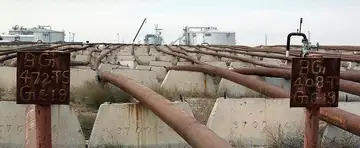
A geologist searching for oil found an inscribed brick, which led to the digging of the site. Roland de Mecquenem dug there in 1935 to 1939 and again in 1946, and Roman Ghirshman led French excavations from 1951 to 1962. The city is believed to have been destroyed by the Assyrian ruler Ashurbanipal around 645 BC, although some researchers think it was abandoned earlier. Seismic tests for oil searches have been a threat to the foundations.
Fun facts
- Today it stands about 25 m tall, less than half its original height.
- Its name means "basket mound".
- The ziggurat was once about 53 metres high, but only 24.75 metres remain.
- 5,257 inscribed bricks have been found at the site.
- It was the first Iranian site on the UNESCO World Heritage List, in 1979.
On the globe
The model shows the stepped mud-brick ziggurat in the desert. Look for its terraces.
Quiz time
Which is taller: Chogha Zanbil or Great Ziggurat of Ur?
Show the answer
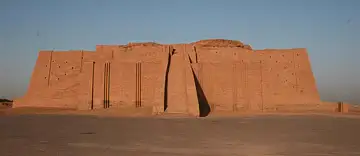
Great Ziggurat of Ur. (25 m vs 30 m) Great Ziggurat of Ur →
Nearby on the globe




Sources
Updated: 2026-10-14