
Santiago de Compostela Cathedral
산티아고 데 콤포스텔라 대성당
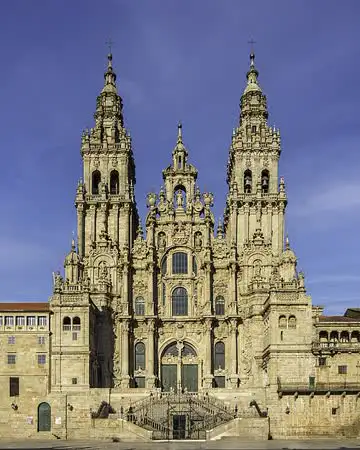
The Cathedral of Santiago de Compostela is a great church in Galicia, in northwest Spain. It is the traditional end of the Camino de Santiago, the Way of St James, a network of pilgrimage routes that people have walked since the early Middle Ages. It is believed to hold the tomb and relics of Saint James the Great, one of the twelve apostles.
See it on the 3D globe →At a glance
- Country
- Spain
- Location
- Santiago de Compostela, Spain
- Built
- 1211
- Height
- 74 m
- Type
- Religious building
Quick answers
Where is Santiago de Compostela Cathedral?
Santiago de Compostela Cathedral is in Santiago de Compostela, Spain.
When was Santiago de Compostela Cathedral built?
Santiago de Compostela Cathedral was built in 1211.
How tall is Santiago de Compostela Cathedral?
Santiago de Compostela Cathedral is about 74 m tall.
The goal of the Camino de Santiago, its Baroque Obradoiro facade and twin towers facing the great square.
The building is part of the UNESCO World Heritage old town of Santiago de Compostela. It is 97 metres long and is the largest Romanesque church in Spain. Work on the present cathedral started in 1075 under King Alfonso VI of Castile, and it is known for its ornate Baroque front, facing the great square, with two tall towers.
History
According to tradition, Saint James spread Christianity in the Iberian Peninsula, and his tomb was rediscovered in the year 814 by a hermit named Pelayo, who saw strange lights in the night sky. King Alfonso II ordered a chapel built there, and pilgrims began to arrive. A pre-Romanesque church was built in 899, but in 997 the army commander of Cordoba burned it, leaving the tomb undisturbed. The present cathedral, built mostly of granite, was begun in 1075 and consecrated in 1211.
The facades and the Portico
The Baroque Obradoiro facade was completed by Fernando de Casas Novoa in 1740, and it is shown on the back of Spain's 1, 2 and 5 euro-cent coins. Behind it lies the Portico da Gloria, an early work of Romanesque sculpture finished by Master Mateo in 1188. The Pratarias facade on the south side, built from 1103 to 1117, is the only Romanesque facade that survives.
Pilgrims and holy years
Pilgrims who finish the Camino arrive in the square in front of the cathedral. Inside, the interior feels plain at first, then opens up to a magnificent organ and an ornate choir. In a Jacobean Holy Year, when St James's Day, 25 July, falls on a Sunday, the Holy Door is opened and a lantern on the Berenguela Tower is lit to guide pilgrims like a lighthouse. A university was added to the city in 1495.
Fun facts
- A giant censer, the Botafumeiro, swings across the church on ropes during big services.
- The Obradoiro facade is on the back of Spain's 1, 2 and 5 euro-cent coins.
- It is the largest Romanesque church in Spain.
- The Holy Door opens only in Holy Years, when 25 July falls on a Sunday.
- Its Berenguela bell weighs about 9,600 kilograms.
On the globe
The model shows the cathedral with its decorated front and twin towers; look for the two towers facing the square.
Quiz time
Which is taller: Santiago de Compostela Cathedral or Aqueduct of Segovia?
Show the answer
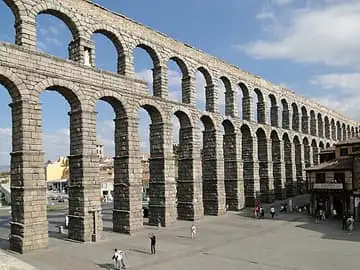
Santiago de Compostela Cathedral. (74 m vs 28 m) Aqueduct of Segovia →
Nearby on the globe


Sources
- Read more on Wikipedia
- Santiago de Compostela Cathedral — Wikipedia (English)
- 산티아고데콤포스텔라 대성당 — Wikipedia (Korean)
- Santiago de Compostela Cathedral — Wikipedia (full article)
Updated: 2026-10-14