
Summer Palace
이화원
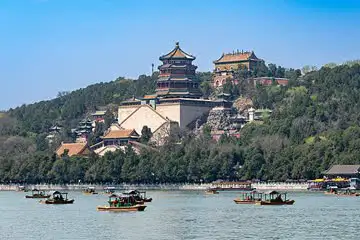
The Qing emperors' summer retreat: Longevity Hill crowned by the Tower of Buddhist Incense above the man-made Kunming Lake, China's largest imperial garden.
See it on the 3D globe →At a glance
- Country
- China
- Location
- Beijing, China
- Built
- 1750
- Height
- 41 m
- Type
- Palace
Quick answers
Where is Summer Palace?
Summer Palace is in Beijing, China.
When was Summer Palace built?
Summer Palace was built in 1750.
How tall is Summer Palace?
Summer Palace is about 41 m tall.
The Summer Palace, or Yihe Garden, is a huge imperial garden of lakes, hills and palaces in the north-west of Beijing, China. It was a retreat for the Qing dynasty rulers, especially the Empress Dowager Cixi. It covers 2.9 square kilometres, and about three-quarters of that is water.
Its two main features are Longevity Hill, about 60 metres high and crowned with the Tower of Buddhist Incense, and Kunming Lake, which is entirely man-made. The Seventeen-Arch Bridge crosses part of the lake. UNESCO called it a masterpiece of Chinese landscape garden design and added it to the World Heritage List in 1998.
A garden dug by hand
The area has been used for royal palaces since the Jin dynasty in the 1100s. Around 1749 the Qianlong Emperor decided to build a palace here to celebrate his mother's 60th birthday, and he had the lake enlarged. The lake is a work of human labour: Kunming Lake covers 2.2 square kilometres, and the soil dug out to make it was piled up to build Longevity Hill. The gardens were inspired by those of southern China, so you will find winding paths, pavilions, halls and bridges set in a natural landscape.
Copies of famous places
The design follows a Chinese legend about three divine mountains on an island in the eastern sea, and the three small islands in Kunming Lake stand for them. The lake itself was modelled on West Lake in Hangzhou, and several buildings imitate famous places in China. The Long Corridor, 728 metres long, is covered with paintings of famous places and scenes from Chinese myths and folktales.
Burned, rebuilt and opened
In 1860, during the Second Opium War, British and French forces sacked and burned the palace and the nearby Old Summer Palace. Empress Dowager Cixi had the Summer Palace rebuilt for her 60th birthday, and it was given its present name, Yiheyuan, in 1888. It was damaged again in 1900. After the Qing dynasty ended it was opened to the public in 1914, and since 1953 many restorations have taken place. Today it is a public park and a treasure house of more than 3,000 ancient buildings and over 40,000 valuable historical objects.
Fun facts
- About three-quarters of the Summer Palace is water, mostly Kunming Lake.
- The lake's soil was piled up to make Longevity Hill.
- The Long Corridor is 728 metres long and painted with scenes from myths and folktales.
- About three-quarters of the Summer Palace is water.
- The Summer Palace is the end point of a 1,267-kilometre water transfer route that brings water to Beijing.
On the globe
The model shows Longevity Hill with its tower beside the lake.
Quiz time
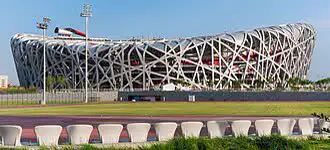
Which is taller: Summer Palace or Beijing National Stadium (Bird's Nest)?
Show the answer
Beijing National Stadium (Bird's Nest). (41 m vs 69 m) Beijing National Stadium (Bird's Nest) →
Nearby on the globe

Sources
Updated: 2026-10-14