
Teotihuacan
테오티우아칸
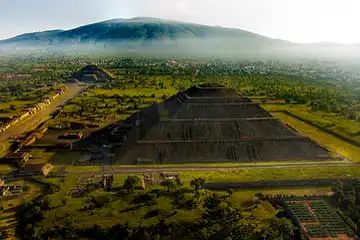
Teotihuacan is the ruins of a huge ancient city about 40 kilometres north-east of Mexico City, in the State of Mexico. Its great monuments were built from roughly 100 BC to AD 250, and at its peak, around AD 350 to 650, it was one of the largest cities in the Americas, with probably about 100,000 people or even more living there.
See it on the 3D globe →At a glance
- Country
- Mexico
- Location
- State of Mexico, Mexico
- Built
- 200
- Height
- 65 m
- Type
- Ancient site
Quick answers
Where is Teotihuacan?
Teotihuacan is in State of Mexico, Mexico.
When was Teotihuacan built?
Teotihuacan was built in 200.
How tall is Teotihuacan?
Teotihuacan is about 65 m tall.
An ancient city of the Pyramids of the Sun and Moon, once among the largest cities in the Americas.
The city is famous for its giant stepped pyramids, the Pyramid of the Sun and the Pyramid of the Moon, joined by a long, straight road called the Avenue of the Dead. Nobody knows what language its builders spoke or what they called their city. The name Teotihuacan was given much later by the Aztecs, and it is often translated as "the place where the gods were born". It became a UNESCO World Heritage Site in 1987.
History
Teotihuacan grew into a powerful city that traded across Mesoamerica, the region of ancient Mexico and Central America. It controlled nearby sources of obsidian, a sharp black volcanic glass used to make tools and weapons. People lived in more than 2,000 walled apartment compounds built around courtyards, and many walls were painted with colourful murals. Around AD 550 to 600 the main temples and palaces were burned. Scientists think trouble inside the city, perhaps made worse by drought, caused the fall, and by about AD 750 it was largely empty.
The great pyramids
The Pyramid of the Sun is about 65 metres tall, with a base of roughly 220 by 230 metres, and it is one of the largest pyramids in the world. It was built over a cave and tunnel that seem to have been a sacred place. The slightly smaller Pyramid of the Moon stands at the north end of the Avenue of the Dead, and inside it are several older pyramids, each covered by a newer, bigger one. At the other end of the avenue is the Temple of the Feathered Serpent.
What scientists found
In 2003 heavy rain opened a sinkhole near the Temple of the Feathered Serpent and revealed a hidden tunnel that had been sealed for about 1,800 years. Archaeologists explored it carefully over many years. About 17 metres underground they found a tiny model landscape with small pools of liquid mercury, a shiny metal that is liquid at room temperature, which may have stood for lakes of an underworld.
Fun facts
- The Pyramid of the Sun is one of the largest pyramids in the world.
- The Aztecs found Teotihuacan already in ruins hundreds of years after it was abandoned, and they gave it the name we use today.
- The whole city was laid out on a grid that is turned about 15.5 degrees east of true north.
- A secret tunnel under one temple held tiny pools of liquid mercury.
- More than 1.3 million people visited Teotihuacan in 2024, making it one of the most visited ancient sites in Mexico.
On the globe
The model shows the ancient city with the Pyramids of the Sun and Moon near Mexico City. Zoom in to compare the two stepped pyramids and see which one is bigger.
Quiz time
Which is taller: Teotihuacan or Palacio de Bellas Artes?
Show the answer
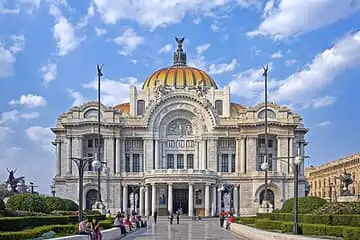
Teotihuacan. (65 m vs 53 m) Palacio de Bellas Artes →
Nearby on the globe

Sources
Updated: 2026-10-13