
Uluru
울루루
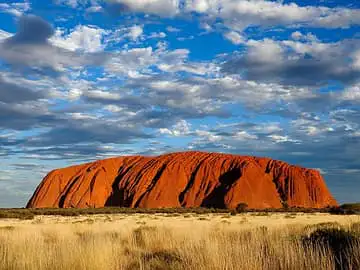
Uluru, also called Ayers Rock, is a giant block of sandstone rising from the flat red desert near the centre of Australia, in the southern part of the Northern Territory. It stands 348 metres above the surrounding plain, reaches 863 metres above sea level, and is 9.4 kilometres around its base. Most of the rock is actually hidden underground, like an iceberg of stone.
See it on the 3D globe →At a glance
- Country
- Australia
- Location
- Northern Territory, Australia
- Height
- 348 m
Quick answers
Where is Uluru?
Uluru is in Northern Territory, Australia.
How tall is Uluru?
Uluru is about 348 m tall.
A massive sandstone monolith in the desert, sacred to the Aboriginal Anangu people.
Uluru is sacred to the Aṉangu, the Aboriginal people who have always lived on this land. Together with Kata Tjuṯa, a group of domed rocks about 25 kilometres to the west, it forms Uluṟu-Kata Tjuṯa National Park, which is on the UNESCO World Heritage List for both its nature and its living culture. It is one of the best-known natural landmarks in Australia.
Why it is sacred
For Aṉangu, Uluru is part of Tjukurpa, a word for their traditional law, stories and beliefs. In these stories, ancestral beings travelled across the land and shaped Uluru and Kata Tjuṯa, leaving marks in the rock that can still be seen. One story tells of Kuniya, a woma python who lived at Uluru and fought Liru, a poisonous snake. Some parts of the rock are linked to ceremonies, so Aṉangu ask visitors not to photograph those places.
Why it glows red
Uluru is made of arkose, a coarse sandstone full of a mineral called feldspar. Fresh rock inside is grey, but iron in the outer layer has slowly rusted, giving the surface its red-brown colour. The rock seems to change colour through the day and glows bright red at sunrise and sunset. Its layers were laid down as sand more than 500 million years ago and were later tipped up until they stood almost on end.
Visiting today
Tourists began coming to Uluru in the 1930s, and a chain was put up in 1964 to help people climb it. Climbing was never welcome under Aṉangu law. In 1985 the park was handed back to its Traditional Owners in an event called Handback, and the park's board later voted to close the climb. It closed for good on 26 October 2019, exactly 34 years after Handback. Today visitors walk around the base, join Aṉangu-led tours and watch the rock change colour at dawn and dusk.
Fun facts
- Uluru's grey rock turns red-brown on the outside because the iron in it has rusted.
- Most of Uluru is underground: the rock layers continue far beneath the desert floor.
- The climb closed on 26 October 2019, the 34th anniversary of the park being handed back to Aṉangu.
- Even in the desert around Uluru you can find frogs living in the sand.
On the globe
The model shows a huge rock rising alone from the desert in central Australia. Zoom in and compare its rounded shape with the flat land all around it.
Quiz time
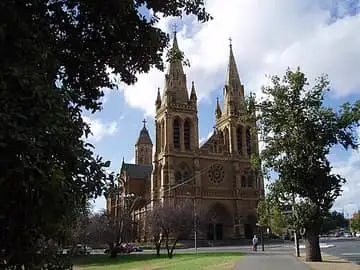
Which is taller: Uluru or St Peter's Cathedral, Adelaide?
Show the answer
Uluru. (348 m vs 51 m) St Peter's Cathedral, Adelaide →
Nearby on the globe


Sources
- Read more on Wikipedia
- Uluru — Wikipedia
- 울루루 — 위키백과
- Aṉangu Culture — Uluṟu-Kata Tjuṯa National Park, Parks Australia
- Uluṟu climb closure — Uluṟu-Kata Tjuṯa National Park, Parks Australia
- Nature — Uluṟu-Kata Tjuṯa National Park, Parks Australia
Updated: 2026-10-13