
University of Oxford
옥스퍼드 대학교
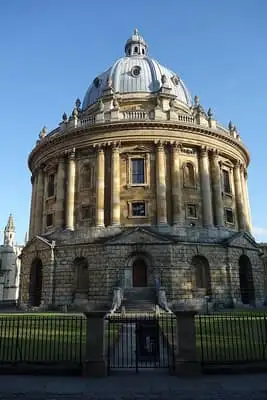
The oldest university in the English-speaking world, with teaching going back to about 1096. The model shows the Radcliffe Camera (1749), the round domed library that has become Oxford's emblem.
See it on the 3D globe →At a glance
- Country
- United Kingdom
- Location
- Oxford, England
Quick answers
Where is University of Oxford?
University of Oxford is in Oxford, England, United Kingdom.
The University of Oxford, in the city of Oxford in England, is the oldest university in the English-speaking world. Nobody knows its exact founding date, but there is evidence of teaching there as early as 1096. It grew quickly after 1167, when King Henry II stopped English students from studying at the University of Paris, and it is the second-oldest university in the world still running today.
Oxford has no single main campus. Instead it is made up of 43 colleges and halls spread across the city centre, each with its own buildings, dining hall and students. About 26,800 students study there. Over the centuries, 31 British prime ministers and dozens of Nobel Prize winners have been linked to the university. Its best-known building is the Radcliffe Camera, a round, domed library finished in 1749.
History
In 1209 a quarrel between scholars and townspeople made some teachers leave Oxford. They settled in Cambridge, and that is how the University of Cambridge began. Oxford received a royal charter in 1248. For hundreds of years only men could study there. The first two colleges for women, Lady Margaret Hall and Somerville, opened in 1879 with just 21 students between them, and women were finally allowed full membership and degrees in 1920. The university also runs the Ashmolean Museum, the world's oldest university museum, and Oxford University Press.
The Radcliffe Camera
The Radcliffe Camera was paid for with money left by John Radcliffe, a royal doctor who died in 1714. The architect James Gibbs designed it, and it was built between 1737 and 1749. It was Britain's first circular library. At first it was called the Radcliffe Library. In 1861 it became part of the Bodleian, Oxford's main library, and was renamed the Radcliffe Camera, from the Latin word camera, meaning room. Beneath the square outside there is an underground book store, dug between 1909 and 1912.
Visiting today
The Radcliffe Camera is still a working library where students read and study, so only registered readers can go in freely. Visitors can see inside on guided tours run by the Bodleian Libraries. Many of the colleges, museums and gardens around it are open to the public at set times, so a walk through the city centre feels like walking through the university itself.
Fun facts
- Teaching at Oxford goes back to at least 1096, almost a thousand years ago.
- The University of Cambridge was started by scholars who left Oxford after a quarrel in 1209.
- The word camera in Radcliffe Camera is Latin for room.
- The Radcliffe Camera was Britain's first circular library.
- Oxford runs the Ashmolean, the world's oldest university museum.
On the globe
The model shows the Radcliffe Camera (1749), the round domed library that has become Oxford's emblem. Look for its circular shape and big dome.
Nearby on the globe


Sources
- Read more on Wikipedia
- University of Oxford — Wikipedia
- Radcliffe Camera — Wikipedia
- Spaces to visit — Bodleian Libraries, University of Oxford
Updated: 2026-10-13