
Vidhana Soudha
비다나 사우다
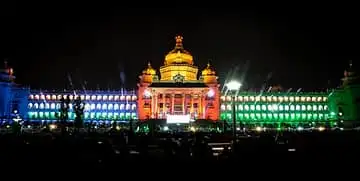
The granite seat of Karnataka's legislature in Neo-Dravidian style, completed in 1956. About 213 m long, it has a portico of twelve 12 m columns at the top of 45 steps and a central dome crowned by the national emblem, 46 m high.
See it on the 3D globe →At a glance
- Country
- India
- Location
- Bengaluru, India
- Built
- 1956
- Height
- 46 m
- Type
- Government building
Quick answers
Where is Vidhana Soudha?
Vidhana Soudha is in Bengaluru, India.
When was Vidhana Soudha built?
Vidhana Soudha was built in 1956.
How tall is Vidhana Soudha?
Vidhana Soudha is about 46 m tall.
Vidhana Soudha, which means 'Legislative House', is the seat of Karnataka's two-house legislature in Bengaluru, India. It was completed in 1956 in the Neo-Dravidian style and is built mainly of granite. It is about 700 feet long from north to south and 53.34 metres tall, and a flight of 45 steps leads up to a porch with twelve granite columns, each 12 metres high.
The central dome is 18 metres wide and is crowned by a likeness of the State Emblem of India. The building is spread over 60 acres and is described as the largest state legislature and secretariat building in India. Chief Minister Kengal Hanumanthaiah called it a 'people's palace', and it has become a symbol of democratic government.
Why this style?
After independence in 1947 the legislature met in Attara Kacheri, a British-built court building, which Hanumanthaiah saw as a sign of colonial rule. He wanted a building rooted in Indian traditions. Historians link the design to two events: a question from Soviet diplomats in 1954 about the many European buildings in the city, and Winston Churchill's 1931 remark about Gandhi on the 'viceregal steps'. The state chose Dravidian architecture. Nehru laid the foundation stone on 13 July 1951.
Building it
Construction ran from 1952 to 1956 and was carried out by the Public Works Department without private contractors. More than 5,000 workers took part, including 1,500 chisellers, masons and wood carvers, and some were prisoners who were freed after finishing the work. The estimate for the original two-storey plan was 33 lakh rupees, and the final cost of the redesigned building was 1.8 crore rupees. The dome was sculpted by Sri Siddalinga Swami and finished by his son Nagendra Stapati.
Architecture and halls
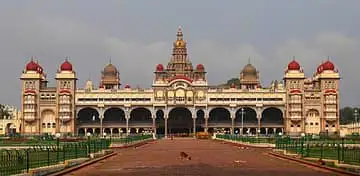
The style blends elements from many places: pillars inspired by the Mysore Palace, temple columns from the Bhoganandishwara Temple, balconies from Rajasthan, and Chalukya, Hoysala and Vijayanagara traditions. The pink and black granite came from Magadi and Turuvekere, and the doors are teak and sandalwood. The assembly hall seats 254 people and the council hall seats 88 members. On the front are written the words 'Government Work is God's Work' in English and Kannada.
Fun facts
- It is the largest legislative building in India.
- The building has 172 rooms, and the chief minister's office is the biggest.
- An inscription says 'Government Work is God's Work'.
- A plan to change the inscription to 'Satyameva Jayate' in 1957 never went ahead.
- Some of the construction workers were prisoners who were released after finishing the work.
On the globe
The model shows the granite building with a row of columns and a central dome. Look for the dome with the national emblem.
Quiz time
Which is taller: Vidhana Soudha or Bangalore Palace?
Show the answer
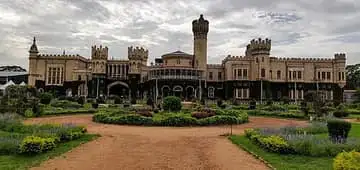
Vidhana Soudha. (46 m vs 30 m) Bangalore Palace →
Nearby on the globe

Sources
Updated: 2026-10-14