
Volubilis
볼루빌리스
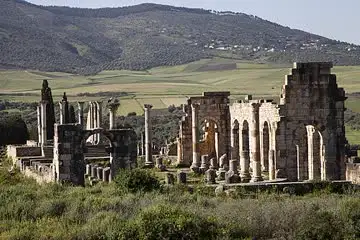
Volubilis is a partly excavated Roman city in Morocco, near the city of Meknes. People settled here from the 3rd century BC, and under Rome it grew into one of the empire's most remote cities, on the south-western edge of the Roman world. Today its ruins stand among olive groves, with the Arch of Caracalla, a basilica and many houses with mosaic floors still to be seen.
See it on the 3D globe →At a glance
- Country
- Morocco
- Location
- Near Meknes, Morocco
- Built
- c. 3rd century BC – 3rd century AD
- Type
- Ancient site
Quick answers
Where is Volubilis?
Volubilis is in Near Meknes, Morocco.
Ruins of a Roman city of Mauretania amid olive country, with the Arch of Caracalla and basilica still standing.
The city covered about 42 hectares and was ringed by a wall about 2.6 km long. It grew rich from olive growing, and its wealthy owners built fine town houses with large mosaics. UNESCO listed Volubilis in 1997 as an exceptionally well preserved large Roman colonial town on the fringes of the empire.
A royal capital and a Roman town
The area has been lived in for about 5,000 years. By the 3rd century BC the Carthaginians had a presence here, and a temple to the god Baal has been found. After the fall of Carthage the land became part of the kingdom of Mauretania, and in 25 BC Emperor Augustus placed Juba II on its throne. Juba, who was raised in Rome and married Cleopatra Selene II, daughter of Mark Antony and Cleopatra, made Volubilis a second capital.
After Rome annexed Mauretania in 44 AD the city grew quickly. It exported grain, olive oil and wild animals for gladiator shows. In the late 2nd century about 20,000 people lived here, and more than 50 villas have been found in the area around it.
Mosaics, olives and walls
Olive oil paid for the city's grand houses. Their floors show gods and heroes, and the Orpheus mosaic and the Labours of Hercules are among the best known. Because the city sat so close to powerful Berber tribes, a ring of forts guarded it, and Marcus Aurelius ordered a wall with eight gates and 40 towers near the end of the 2nd century. Even so, Roman rule collapsed around 280 to 285 and was never restored here.
After the Romans
The city did not die at once. For at least another 700 years it was home first to a Latin-speaking Christian community and then to an early Islamic settlement. In the late 8th century Idris ibn Abdallah, founder of Morocco's Idrisid dynasty, settled here. By the 11th century the city was abandoned as power moved to Fes, and many people moved to nearby Moulay Idriss Zerhoun. A strong earthquake in 1755 and stone-hunting for Meknes did much damage. About half the site has since been excavated, and some buildings were restored or rebuilt.
Fun facts
- 58 olive oil workshops have been found.
- The name may come from an Amazigh word for the oleander flowers that grow in the valley.
- Local people call the ruins 'Qasr Fara'on', meaning Pharaoh's Palace.
- Hebrew inscriptions found here are the most south-western known from ancient times.
On the globe
The model shows Roman ruins with columns and the Arch of Caracalla among olive country. Look for the triumphal arch.
Nearby on the globe

Sources
Updated: 2026-10-14