
Chefchaouen
셰프샤우엔
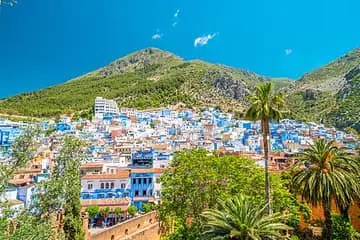
Chefchaouen is a small city in the Rif Mountains of northwestern Morocco, famous for its houses and lanes washed in shades of blue. It is nicknamed the "Blue Pearl" and sits about 600 metres above sea level, between the towns of Tétouan and Ouazzane. In the 2024 census it had about 46,000 people. Its blue streets make it one of Morocco's most photographed places.
See it on the 3D globe →At a glance
- Country
- Morocco
- Location
- Rif Mountains, Morocco
- Built
- 1471
- Type
- Historic district
Quick answers
Where is Chefchaouen?
Chefchaouen is in Rif Mountains, Morocco.
When was Chefchaouen built?
Chefchaouen was built in 1471.
A mountain town whose lanes and houses are washed in shades of blue, known as the Blue Pearl.
The city was founded in 1471 as a small fortress, called a kasbah, built to defend the area against Portuguese attacks. Its name comes from Arabic and Berber words meaning "look at the horns", which describes the two mountain peaks above the town.
History
The fortress was built by Ali ibn Rashid al-Alami. As the Reconquista pushed Muslims and Jews out of Spain and Portugal, many refugees settled here, and they built quarters on the mountain slopes in the style of Granada. In a few decades the fortress grew into a prosperous city with walls, about ten gates and a Great Mosque.
Spanish troops took the city in 1920, and in the 1920s it was briefly part of the Republic of the Rif, led by Abd el-Krim. Spain returned the area to Morocco in 1956.
Why is it blue?
Nobody is certain why the walls are blue. One popular idea is that the colour keeps mosquitoes away. Another says the blue stands for the sky and heaven and reminds people to live a spiritual life.
Whatever the reason, the old town, or medina, is full of white and blue houses with narrow lanes, and visitors come mostly to wander through them.
Life in the old town
Traditional houses were made of stone, brick, tile, wood, soil and lime. Each has an open courtyard in the middle with corridors and bedrooms around it. The courtyards are often planted with oranges, lemons, grapes and sweet-smelling shrubs such as jasmine.
The city is influenced by Andalusian architecture, such as curved brick archways. It has also long traded with nearby mountain peoples of the Jbala region.
Fun facts
- The name Chefchaouen means roughly "look at the horns", after the two peaks above the city.
- The town was founded in 1471 as a small fortress.
- Many refugees from Spain built quarters here in the style of Granada.
- Its old courtyards are often planted with orange and lemon trees and jasmine.
On the globe
The model shows a hillside town of blue-washed houses and narrow lanes; look for the cluster of blue buildings.
Quiz time
Which is older: Chefchaouen or Plaza de España, Seville?
Show the answer
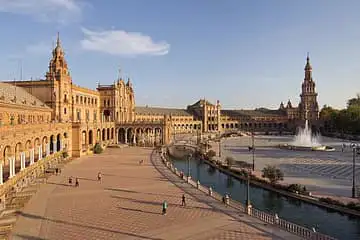
Chefchaouen. (1471 vs 1928) Plaza de España, Seville →
Nearby on the globe

Sources
Updated: 2026-10-14