
Antarctic fur seal
남극물개
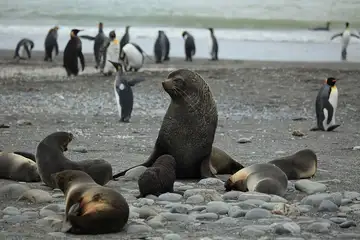
A fur seal that gathers in huge colonies on the rocky shores of sub-Antarctic islands, most of them on South Georgia. Males are much bigger than females and have a mane. Its dark fur is very dense.
See it on the 3D globe →At a glance
- Class
- Mammals
- Lives in
- Sub-Antarctic islands of the southern Indian Ocean (Heard, Kerguelen)
- Diet
- Meat eater (carnivore)
- Conservation status
- Endangered (IUCN EN)
- Habitat
- polar regions, coasts
Quick answers
Where does the Antarctic fur seal live?
It lives in polar regions, coasts of the Southern and Atlantic oceans. On the globe you can find it near Sub-Antarctic islands of the southern Indian Ocean (Heard, Kerguelen).
What does the Antarctic fur seal eat?
Its diet: meat eater (carnivore).
Is the Antarctic fur seal endangered?
It is listed as Endangered (IUCN EN).
The Antarctic fur seal is a mid-sized seal that lives mostly on the sub-Antarctic islands, even though its name says Antarctic. Its scientific name probably comes from the German ship SMS Gazelle, which first collected specimens at the Kerguelen Islands.
Huge colonies gather on rocky shores, and most are on South Georgia. Males are much bigger than females and have a mane. The card describes its dark fur as very dense. It is one of eight seals in the genus Arctocephalus and one of nine fur seals in its subfamily. Quiz data lists it as a carnivore that lives in the Southern and Atlantic oceans.
Size and looks
Males grow up to 2 m long with an average weight of 133 kg, while females reach about 1.4 m and 34 kg. Adult males are dark brown, and females and young are paler grey with lighter undersides.
It has a long neck, a pointed muzzle, long whiskers up to 35 to 50 cm and long, bare-tipped external ears. Pups are dark brown, almost black, at birth.
Hunted and recovered
The card says it was hunted almost to extinction in the 1800s but recovered, and quiz data adds that most now breed on South Georgia. A 2026 IUCN update, noted in the quiz data, changed its status from Least Concern to Endangered.
Genetic studies suggest there are two distinct regions: a western group on islands of the Scotia Arc and a group around Kerguelen and Macquarie.
Fun facts
- Hunted almost to extinction in the 1800s, it recovered, and most now breed on South Georgia.
- Its whiskers can be up to 50 cm long.
- Most of the species breeds on South Georgia.
- Males can be nearly four times heavier than females.
On the globe
The model shows an Antarctic fur seal on a rocky shore. Look for the dark, dense fur and the pointed muzzle.
More like this
.jpg)
Sources
Updated: 2026-10-14