
Numbat
넘뱃
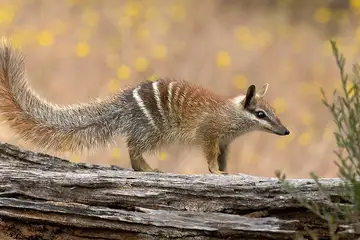
The numbat is a small marsupial of south-western Australia, marked with white stripes across its rump. It is active by day and eats about 20,000 termites a day with a very long tongue. It is endangered.
See it on the 3D globe →At a glance
- Class
- Mammals
- Lives in
- South-western Western Australia
- Diet
- Insect eater
- Weight
- about 0.55 kg
- Length
- about 0.4 m
- Conservation status
- Endangered (IUCN EN)
- Habitat
- forests
Quick answers
Where does the Numbat live?
It lives in forests. On the globe you can find it near South-western Western Australia.
How big is the Numbat?
It grows to about 0.4 m and 0.55 kg.
What does the Numbat eat?
Its diet: insect eater.
Is the Numbat endangered?
It is listed as Endangered (IUCN EN).
The numbat (Myrmecobius fasciatus) is a small, insect-eating marsupial from Western Australia, also known as the noombat or walpurti. It has white stripes across its rump and a bushy tail about as long as its body, with a head and body that together measure 35 to 45 centimetres. It weighs between 280 and 700 grams.
It was once widespread across southern Australia, but is now restricted to several small colonies in Western Australia. It is therefore listed as endangered and protected by conservation programmes. Numbats have also been brought back to fenced reserves in South Australia and New South Wales. It is the faunal emblem of Western Australia, and the first record of the species described it as beautiful.
A daytime termite eater
Unlike most small marsupials, the numbat is active by day, and it feeds almost only on termites. An adult needs up to 20,000 termites each day. It digs them out of loose earth with its front claws and catches them with a long, sticky tongue. Because termites hold plenty of water, a numbat gets most of its water from its food.
Its claws are not strong enough to break into concrete-like termite mounds, so it uses its sense of smell to find shallow underground tunnels and waits until the termites are active. In winter it feeds from mid-morning to mid-afternoon, and in summer it rests in the heat of the day.
A family of one
Numbats are the only living members of their family, Myrmecobiidae. Genetic studies suggest their ancestors split from other marsupials between 32 and 42 million years ago. A reddish subspecies has been extinct since at least the 1960s. The name numbat comes from the Nyungar language of southwest Australia, and walpurti from the Pitjantjatjara.
Like other termite-eaters, it has a degenerate jaw with up to 50 tiny teeth that it rarely uses to chew. At night it sleeps in a hollow log or a narrow burrow, and it can block the entrance with the thick hide on its rump.
Bringing numbats back
When Europeans arrived, numbats lived across western, central and southern Australia. The release of the European red fox in the 19th century is presumed to have wiped them out in much of their range. By the late 1970s fewer than 1,000 remained, mostly at Dryandra forest and Perup near Perth, where many hollow logs offer shelter.
Being active by day makes numbats easy prey for eagles, hawks and carpet pythons, as well as foxes and feral cats. Reintroductions to fenced reserves help the species recover.
Fun facts
- Other names include noombat and walpurti.
- Numbats are diurnal, unlike many marsupials.
- A numbat may eat up to 20,000 termites in one day.
- It can slip into torpor, a deep rest, for up to fifteen hours a day in winter.
On the globe
The model shows a numbat with its striped back and bushy tail.
Quiz time
Which is heavier: Numbat or Quokka?
Show the answer
Quokka. (0.55 kg vs 3.5 kg) Quokka →
More like this


Sources
Updated: 2026-10-14