
Antarctic minke whale
남극밍크고래
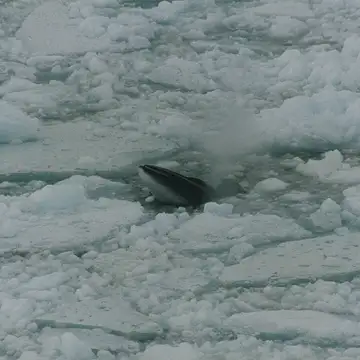
A small baleen whale of the Southern Ocean, about 9-10 m long, dark grey above and white below. It is often seen among sea ice and feeds mainly on krill.
See it on the 3D globe →At a glance
- Class
- Mammals
- Lives in
- Southern Ocean, Indian sector (about 63°S)
- Diet
- Filter feeder
- Weight
- about 7,000 kg
- Length
- about 9 m
- Conservation status
- Near Threatened (IUCN NT)
- Habitat
- polar regions, open ocean
Quick answers
Where does the Antarctic minke whale live?
It lives in polar regions, open ocean of the Southern, Pacific, Atlantic and Indian oceans. On the globe you can find it near Southern Ocean, Indian sector (about 63°S).
How big is the Antarctic minke whale?
It grows to about 9 m and 7,000 kg.
What does the Antarctic minke whale eat?
Its diet: filter feeder.
Is the Antarctic minke whale endangered?
It is listed as Near Threatened (IUCN NT).
The Antarctic minke whale lives in the cold waters of the Southern Hemisphere and is often seen among sea ice. It is a small baleen whale, about 9 to 10 metres long, with a dark grey back and a white belly. Baleen whales have no teeth. They have bristly plates in their mouths that strain tiny animals from the water, and this whale feeds mainly on krill.
It is the second smallest rorqual, the family of streamlined whales with throat grooves, and the third smallest baleen whale. Because it was small and gave little oil, whalers long ignored it, so it kept a large population. Today it is thought to be the most abundant baleen whale in the world, numbering in the hundreds of thousands.
A whale that was long mistaken
The first Antarctic minke was described in 1867 by the zoologist Hermann Burmeister, after a fisherman found a dead one floating in the Río de la Plata near Buenos Aires. Another description came in the 1870s from a specimen taken off New Zealand. Both were mostly forgotten for about a hundred years. Scientists only agreed that it was a separate species from the common minke in the 1990s.
Life among the ice
This whale stays mostly in the Southern Hemisphere, although a few stray animals have been reported in the North Atlantic. It feeds mainly on euphausiids, the shrimp-like animals we call krill. Its small size and slim shape let it slip into gaps in the sea ice, which is why photographers often meet it close to ice floes.
Fun facts
- One of the smaller baleen whales, it feeds on krill near the Antarctic sea ice in summer.
- It is the most abundant baleen whale in the world.
- Whalers ignored it for decades because it was so small and gave so little oil.
- It was not recognised as its own species until the 1990s, even though it was named in 1867.
- Its main food is krill.
On the globe
The model shows a slim, dark-backed whale with a pale underside, as the card describes. The Antarctic minke is among the smaller baleen whales.
Quiz time
Which is heavier: Antarctic minke whale or Weddell seal?
Show the answer
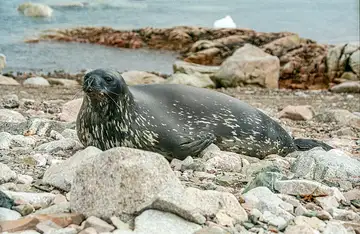
Antarctic minke whale. (7,000 kg vs 500 kg) Weddell seal →
More like this

Sources
Updated: 2026-10-14