
Asiatic black bear (Moon bear)
반달가슴곰
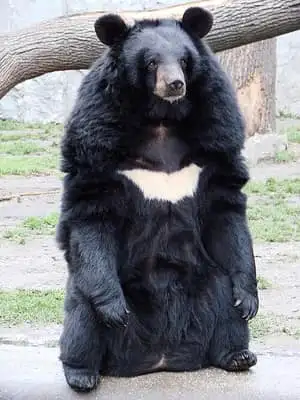
A bear with a white crescent on its chest, reintroduced to Jirisan as an endangered species. It loves acorns and fruit, and in winter it dens in a hollow tree or rock cave to sleep through the cold.
See it on the 3D globe →At a glance
- Class
- Mammals
- Lives in
- Jirisan, South Korea
- Diet
- Eats both plants and meat (omnivore)
- Weight
- about 100 kg
- Length
- about 1.5 m
- Lifespan
- up to about 30 years
- Conservation status
- Vulnerable (IUCN VU)
- Habitat
- forests, mountains
Quick answers
Where does the Asiatic black bear (Moon bear) live?
It lives in forests, mountains. On the globe you can find it near Jirisan, South Korea.
How big is the Asiatic black bear (Moon bear)?
It grows to about 1.5 m and 100 kg.
What does the Asiatic black bear (Moon bear) eat?
Its diet: eats both plants and meat (omnivore).
How long does the Asiatic black bear (Moon bear) live?
It can live up to about 30 years.
Is the Asiatic black bear (Moon bear) endangered?
It is listed as Vulnerable (IUCN VU).
The Asian black bear, often called the moon bear, is a medium-sized bear with a pale V-shaped or crescent patch on its chest. It lives in forests and mountains from Iran and the Himalayas to Southeast Asia, the Korean Peninsula, China, the Russian Far East, Taiwan and Japan. It is Vulnerable on the IUCN Red List.
In South Korea the animal is called the banddalgamseum-gom and is a symbol of wildlife restoration. Since 2004, bears have been released in Jirisan National Park to bring a lost wild population back. The bear is a very good tree climber. The Korean bear belongs to a subspecies called the Ussuri black bear, which lived on the Korean Peninsula before numbers dropped.
Body and food
Adults are about 130 to 190 centimetres long. Males weigh roughly 110 to 150 kilograms and females 65 to 90 kilograms. It is mostly a plant eater, feasting on shoots, nuts, acorns and fruit, and it loves honey, though it sometimes eats small animals. It is well adapted to life in trees and climbs well. It has a thick body, a black coat and a pale chest mark. Its closest relative is the American black bear, from which it split about three million years ago, according to some studies.
Winter sleep and threats
In winter the bear hibernates, usually sleeping in a hollow tree or rock cave. It has sharp senses of smell and hearing, and a mother gives birth to about two cubs on average. Habitat loss from deforestation and hunting for body parts used in traditional medicine are its biggest threats. Because moon bears need big forests with trees full of acorns and fruit, protected areas such as national parks give them room to live and sleep through winter in peace.
Fun facts
- Since 2004, South Korea has been releasing moon bears into Jirisan National Park to bring them back to the wild.
- The pale chest mark gives the moon bear its name.
- The Korean bear is a subspecies called the Ussuri black bear.
- Asian black bears are skilled tree climbers.
On the globe
The model shows a moon bear with its white crescent on the chest, as in the bears released in Jirisan.
Quiz time
Which is heavier: Asiatic black bear (Moon bear) or Water deer?
Show the answer
Asiatic black bear (Moon bear). (100 kg vs 12 kg) Water deer →
More like this
.JPG)
Sources
Updated: 2026-10-14