
Sika deer
꽃사슴
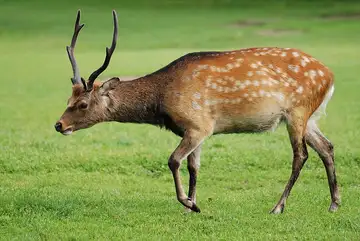
The sika deer has a chestnut summer coat covered in white spots and a white rump patch. Native to East Asia, it roams freely among visitors at Nara Park in Japan. Stags usually carry four-pointed antlers.
See it on the 3D globe →At a glance
- Class
- Mammals
- Lives in
- Nara Park, Japan and East Asia
- Diet
- Plant eater (herbivore)
- Conservation status
- Least Concern (IUCN LC)
- Habitat
- forests
Quick answers
Where does the Sika deer live?
It lives in forests. On the globe you can find it near Nara Park, Japan and East Asia.
What does the Sika deer eat?
Its diet: plant eater (herbivore).
Is the Sika deer endangered?
It is listed as Least Concern (IUCN LC).
The sika deer (Cervus nippon), also called the northern spotted deer or Japanese deer, is a deer of East Asia that has also been introduced to other parts of the world. It is famous for the white spots on its chestnut summer coat, a white patch on the rump, and four-pointed antlers on stags. Its name comes from shika, the Japanese word for deer, and in Chinese it is plum blossom deer, because the spots look like plum flowers.
It once ranged from northern Vietnam in the south to the Russian Far East in the north, but it was overhunted to the brink of extinction in the 19th century. Protection laws in the mid-20th century led to a rapid recovery from the 1950s to the 1980s. In Japan, sika deer roam freely in Nara Park and among the temples of Nara, where they are seen as messengers of the Shinto gods.
Bowing deer of Nara
In Nara, sika deer have learned to bow their heads before being fed special deer cookies, called shika senbei, so they are known as bowing deer. They are found all through the city, in Nara Park and at temples such as Todai-ji.
Deer also bow to show they are about to headbutt, which they do for play and to show dominance. If a person bows to a deer, it may take it as a challenge and bow back before charging. In Shinto the deer is a kind of messenger between mortals and the kami, the spirits.
The rut and the fawn
Sika males are territorial and keep groups of females during the rut, which peaks from early September to November. They mark their territory with scrapes, holes up to 1.6 metres wide dug with the forefeet or antlers, and urinate into them to make a strong, musky smell. Fights with antlers and hooves can be fierce and sometimes fatal.
Pregnancy lasts seven months, and a doe gives birth to one fawn of 4.5 to 7 kilograms. The mother hides it in thick undergrowth, where it lies still and quiet until she returns to nurse it. A fawn becomes independent at 10 to 12 months and is mature at 16 to 18 months. In captivity sika deer live 15 to 18 years.
A noisy, adaptable deer
Sika deer are active through the day, but become nocturnal where people disturb them a lot. In mountain areas such as Japan, they move seasonally, with winter ranges up to 700 metres lower than summer ones. They are also very vocal, with more than ten sounds, from soft whistles to loud screams.
Sika can breed with red deer, their closest relative. In the Scottish Highlands, interbreeding with introduced sika has been called a serious threat to the gene pool of native red deer. Genetic mixing has also muddled the status of many sika subspecies, especially in China.
Fun facts
- In Nara, Japan, over 1,000 sika deer roam freely and are seen as sacred messengers; some even bow to people.
- The Chinese name means plum blossom deer.
- The word sika comes from the Japanese word for deer.
- Newborn fawns lie still and hidden in brush while the mother is away.
- In Nara, deer bow before being fed deer cookies.
On the globe
The toy model shows a spotted sika deer at Nara Park, Japan, and across East Asia.
More like this


Sources
Updated: 2026-10-14