
Yangtze finless porpoise
양쯔강무지개돌고래
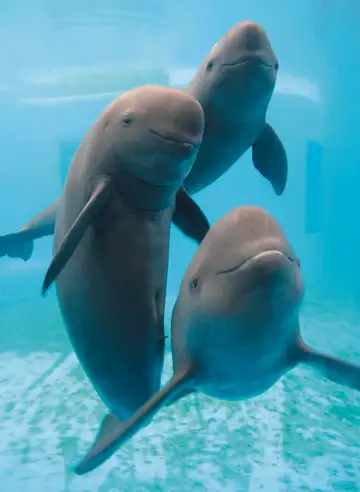
The only freshwater porpoise, it has a rounded head, a smiling mouth and no dorsal fin. Pressure on the Yangtze has made it critically endangered, with roughly 1,400 animals left.
See it on the 3D globe →At a glance
- Class
- Mammals
- Lives in
- Middle and lower Yangtze River, China
- Diet
- Fish eater
- Weight
- about 45 kg
- Length
- about 1.6 m
- Conservation status
- Critically Endangered (IUCN CR)
- Habitat
- rivers & lakes
Quick answers
Where does the Yangtze finless porpoise live?
It lives in rivers & lakes. On the globe you can find it near Middle and lower Yangtze River, China.
How big is the Yangtze finless porpoise?
It grows to about 1.6 m and 45 kg.
What does the Yangtze finless porpoise eat?
Its diet: fish eater.
Is the Yangtze finless porpoise endangered?
It is listed as Critically Endangered (IUCN CR).
The Yangtze finless porpoise is a small toothed whale that lives only in the Yangtze River of China and its connected lakes. It is the only freshwater porpoise, and since the baiji river dolphin is probably extinct, it is China's only known freshwater cetacean. In Chinese it is called jiangtun, which means 'river piglet'. It is critically endangered, with about 1,400 left in recent counts.
It has a rounded head with a steep forehead and no beak, and instead of a back fin it has a flat back with a ridge of small bumps called tubercles. The bumps are sensory organs and also help it move through water. Most adults are 1.5 to 1.8 metres long and weigh around 45 kg. Newborns are dark grey or black and lighten to grey within a few months. It uses echolocation and ultrasonic pulses to communicate, not whistles like most dolphins.
Life in the river
The porpoise lives in the main river and connecting lakes, in shallow bays, swamps and estuaries, all year round. It is shy and does not often come to the surface when people are nearby. Groups usually have three to six animals, though groups of 20 have been reported. It dives for one long dive followed by two shorter ones, and it sometimes leaps from the water and does 'tail stands'. It eats a range of fish, depending on the season.
Danger on the river
The Yangtze is one of the busiest rivers on Earth. Illegal fishing with gillnets, boat traffic, sand mining, pollution, dams and underwater noise all threaten the porpoise. Propellers can injure it, and boat noise can mask its calls and disturb its sonar. A study estimated a high chance that it could become extinct within the next 100 years. China has given it the highest protection level, National First Grade Key Protected Wild Animal.
A glimmer of hope
China put a 10-year fishing ban on the Yangtze starting in 2021. According to a 2026 report by China's Ministry of Agriculture and Rural Affairs, the number of Yangtze finless porpoises rose by 177 compared with 2022. Scientists think the porpoise's ancestors were sea animals that moved into the river. The Yangtze porpoise and the East Asian finless porpoise are now treated as separate species because they have not exchanged genes for thousands of years.
Fun facts
- The only porpoise that lives in fresh water, it is the last whale or dolphin left in the Yangtze after the baiji vanished.
- It is the only freshwater porpoise.
- Its Chinese name means 'river piglet'.
- It has no back fin, only a bumpy ridge.
- China banned fishing in the Yangtze for 10 years from 2021.
On the globe
The model shows a small grey porpoise with a rounded head and no back fin, as in the card. Look at the smooth back and rounded head.
Quiz time
Which is heavier: Yangtze finless porpoise or Chinese white dolphin?
Show the answer
Chinese white dolphin. (45 kg vs 190 kg) Chinese white dolphin →
More like this



Sources
Updated: 2026-10-14